Technology, Mapping and Detection
Weapons detection technology is the fastest way to make prevention measurable, and the fastest way to waste a budget. Both are true, and which one an organization gets depends almost entirely on decisions made before anything is purchased.
We do not sell weapons detection technology and we do not resell software. We assess capability categories against what an organization is actually trying to prevent, and we write findings a buyer can take to procurement. That independence is the point. A recommendation is worth nothing if the person making it earns a commission on the answer.
What weapons detection technology can do, and what it cannot
Every category below shortens the distance between something happening and somebody knowing. None of them decides what happens next. That decision belongs to a person, working from a plan, who has been trained and who knows where to route what they just learned.
| Capability category | What it does | What it does not do |
|---|---|---|
| Weapons detection | Screens people and bags at a controlled point of entry | Cover an entrance nobody is watching a |
| Video analytics | Flags a pattern in a camera feed faster than a human watching a wall of monitors | Replace the human. It changes what the human is asked to look at |
| Gunshot detection | Shortens the gap between a shot fired and a response dispatched | Operate before the first shot, which is where prevention lives |
| Indoor Situational Mapping & Digital Twin | Gives responders the interior of a building before they are standing in it | Stay accurate on its own. A map is only as current as its last update b |
| Mass notification | Reaches everyone at once, on the devices they actually carry | Tell people what to do, unless somebody wrote that part first |
| Facial authentication | Verifies that a known, enrolled person is who they claim to be | Identify an unknown face in a crowd. That is a different technology and a different debate c |
Source: ASPP™ capability assessment practice, vendor agnostic, as of August 2026.
a Screening moves the problem to the perimeter it does not cover. Every assessment counts the doors nobody screens.
b Renovations, furniture moves and door hardware changes all silently invalidate a map.
c Authentication and recognition are frequently conflated in marketing material. They are not the same capability and they do not carry the same policy questions.
How we read a vendor claim
Marketing numbers are not evidence. Independent benchmarks are, and where an independent benchmark exists we point at the source rather than repeating a placement, because standings move and the published record is the authority. Scylla is an independent partner in the ASPP™ Community of Experts, and their published results can be read directly on the public COCO leaderboard at CodaLab or at scylla.ai.
Scylla published our own read of where that detection still fails and what closes it, Closing the Gaps: weapon detection and AI video analytics, on their site rather than ours. Benchmarks are also only half of a procurement decision. Federal law governs whose equipment a buyer may install at all, and Section 889 of the Fiscal Year 2019 National Defense Authorization Act restricts federal agencies, contractors and federal grant recipients from procuring certain covered telecommunications and video surveillance equipment. An organization spending grant money can select a well-benchmarked product and still be ineligible to install it. More on independent benchmarking and Section 889.
The P.R.O. Model™ at a Department of Defense installation
On September 18, 2024, the Blue Grass Army Depot in Richmond, Kentucky ran a live demonstration of artificial-intelligence intruder and active shooter detection. Fifty people attended. Among them were Drew Walter, deputy assistant secretary of defense for nuclear matters, representatives for Senator Mitch McConnell, Senator Rand Paul and Representative Andy Barr, officials from the Madison County and Berea Independent school districts, and Chris Grollnek, Chairman of the Board & Founding Principal.
The Army published the account itself, and in it describes Grollnek as “one of the country’s foremost authorities on active shooters.” He was quoted on what the depot had built:
“Leveraging technology while building on the human experience, Scylla’s true neural network artificial intelligence is fundamentally changing the landscape of how we prevent and respond. Once a bad actor is in motion, whether a terrorist threat, foreign force or violent criminal attack, this comprehensive initiative that Blue Grass Army Depot has created will prove critical in foiling an attack.”
Chris Grollnek, quoted by the U.S. Army, October 8, 2024
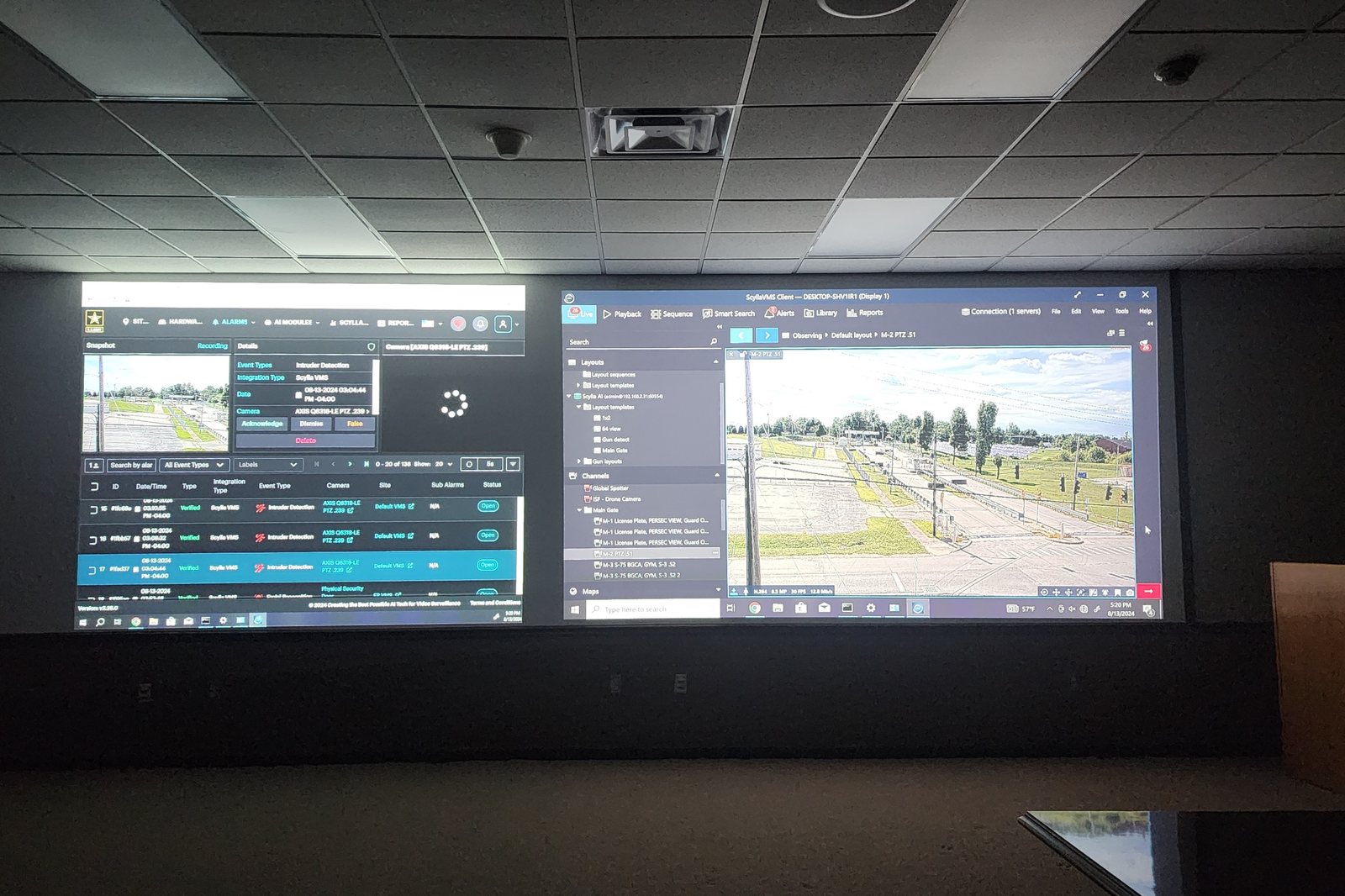
This belongs on a technology page rather than a press page, and the reason is the sequence. The depot did not buy a product and call it a program. It ran eight months of testing, wrote the concept of operations itself, submitted the project, and had it selected by the Army and the Department of Defense Physical Security Enterprise and Analysis Group as one of the top overall submissions of fiscal year 2024. Assessment first, operations written second, technology filling the gaps that people and procedure cannot close on their own.
That order is the P.R.O. Model™ working exactly as designed, and it behaves the same way on a munitions depot as it does in a school district, which is precisely why two school districts sent people to stand in that field and watch. The threat does not change shape because the fence line is federal.
Read the primary sources rather than our summary: the U.S. Army account of the demonstration, and Stars and Stripes on the follow-on Navy testing.
The order that actually works
Technology purchased first and assessed second is how organizations end up with cameras pointed at a door that should have been rehung. Assessment comes first, because it establishes what the building is doing wrong before anything gets wired to it. Then the technology fills the gaps that people and procedure cannot close on their own.
None of this reduces risk to zero. Residual risk never reaches zero, and any vendor who tells you otherwise has told you something useful about the vendor. What good technology does is buy time and information, and in this discipline both convert directly into lives. Information that cannot reach the people who need it is a different problem, and we wrote about how large that problem gets when it took a presidential directive to move data the government already owned.
Common questions
Do you recommend specific products?
We assess categories and write findings against your requirements. Where a named product is genuinely the right fit we will say so, but we take no commission and hold no reseller agreements, so the recommendation costs us nothing either way.
Is weapons detection technology worth it for a mid-sized organization?
Sometimes. It depends almost entirely on whether you control your entrances. Screening one door in a building with six unmonitored ones buys very little, and the assessment usually finds that out before the quote does.
What is a digital twin, in plain terms?
A current, accurate interior model of your building that a responder can read on arrival instead of guessing. The value is entirely in whether it is kept current.
Will AI cameras prevent an attack?
They shorten detection. Prevention happens earlier than any camera operates, in the planning phase, and that work is done by people who know what to look for and where to report it.
Further reading
- Independent Benchmarking and Section 889
- Why Indoor Mapping Matters
- Integrating Weapons Detection and Gunshot Sensor Systems
- Technology to Deter and Prevent
- Eliminating the Gap Between Detection and Police Response
- AI-Powered Surveillance
- Smarter Tools for Safer Communities
- Objectivity in an AI-Driven World
- BGAD Tests AI for Enhanced Security
- Swatting Starts and Ends with Technology
- Emergency Communication Technology Visionary Joins ASPP™
#NEVERHERE™ is the destination. The P.R.O. Model™ is how we get there.
The P.R.O. Model™ · P.R.O. Model™ Workshops · Request a consultation
Related ASPP Services
- Training, Assessments and Workshops. Assessment, workshop and training delivery built on the P.R.O. Model™.
- Active Shooter Incidents and What They Teach. What past attacks reveal about the window before the first shot.
- The Community of Experts. The subject matter experts who support ASPP engagements.
- Mission, Standards and Why We Do This. Who we are, the standards we hold, and why prevention comes first.
Further Reading
- When Seconds Decide Outcomes. Detection, the digital twin, and the indoor drone.
The technology layer, capability by capability
This is written by capability, not by brand. ASPP™ does not sell, resell, or take a margin on any of it. That independence is the reason an assessment finding is worth reading, because nothing in it is steering you toward a product line.
| Capability | What it actually does | Where it sits in the P.R.O. Model™ |
|---|---|---|
| Weapons detection | Screens people and bags at a point of entry without turning the entrance into an airport | Prevention, at the boundary |
| Video analytics and computer vision | Watches feeds no human can watch continuously, and flags a weapon or an abnormal behavior in seconds | Prevention, then Response |
| Gunshot detection | Confirms and locates a shot, which removes the minutes normally lost to disbelief and conflicting reports | Response |
| Access control and screening | Decides who is allowed where, and creates the record of it | Prevention |
| Indoor mapping | Gives responders the inside of a building they have never entered, floor by floor | Response and Options |
| Digital twin | A live model of the building that planning, drills, and response all read from | All three |
| Building information management | The authoritative record of how the structure is actually built, including the systems behind the walls | Prevention and Response |
| Data visualization | Turns all of the above into something a commander or an administrator can act on under pressure | All three |
| Unmanned aircraft | Overwatch, perimeter, and interior reconnaissance where sending a person first is the wrong answer | Response and Options |
| Drone denial and counter unmanned systems | Detects, identifies, and addresses aircraft that should not be over your site | Prevention |
| Mass notification | Reaches everyone at once, which is the hinge between knowing and acting | Response |
None of these is a program on its own. A camera that nobody watches, a map nobody has opened, and a notification system nobody has tested are three purchases, not a prevention plan. The value is in how they hand off to each other, and in whether the people in the building know what to do when one of them fires.
Detection at venue scale