
By Chris Grollnek, Active Shooter Expert
AI-powered surveillance is the difference between a camera that records an event and a system that interrupts one. A camera on its own is a witness, and a good one. It does not blink, and it does not forget. After the worst day in an organization’s history, it will replay that day with perfect fidelity. That is also the limit. A witness testifies afterward. Seeing is not intervening, and a wall of cameras that nobody can effectively watch is documentation infrastructure, not prevention.
We treat detection as prevention infrastructure because of what the warning window is worth. Twice, the Department of Justice selected ASPP™’s P.R.O. Model™ as “A” national standard for active shooter prevention, first for 2022 through 2025 and again for 2026 through 2030, with the resulting training made available to the entire Department of Justice on a biannual basis. The P.R.O. Model™ is also in use at some installations and commands across the Department of Defense. The model puts prevention first on purpose. The earliest decisions are the most powerful ones. Technology that moves detection earlier belongs to prevention, and technology that quietly rebuilds yesterday’s response model does not.
What Can a Camera Do Without AI?
It can record, deter a little, and help investigators afterward. All three matter, and none of them stop anything. The uncomfortable truth of traditional surveillance is that its value has always arrived after the event. It arrives in the playback room, where footage explains what happened to people who could not change it.
Organizations know this and still equate camera count with safety. The camera wall is visible in a way prevention never is. But just because a camera sees something does not mean anyone does anything about it. Between the lens and the action stands a human being. That person has to notice, in real time, on the right screen, at the right second. That is where the math breaks.
How Many Screens Can One Person Actually Watch?
Fewer than any staffing plan assumes, and not because operators are careless. Sandia National Laboratories reviewed the vigilance literature for exactly this problem. It found what a century of research keeps finding: sustained-attention performance declines measurably within the first half hour of a watch. The pattern is so reliable it has a name, the vigilance decrement (Vigilance: A Review of the Literature and Applications to Sentry Duty, SAND2014-17929).
Peer-reviewed work on CCTV specifically says the same thing. A study in Applied Ergonomics documented vigilance decrements in closed circuit television surveillance operators as work exposure accumulated. Research published in PLOS ONE found that even experienced operators miss unexpected events in plain view, a phenomenon called inattentional blindness. The security industry has long circulated a sharper version of this claim. It holds that an operator misses nearly half of screen activity after twelve minutes, and almost all of it after twenty two. The original study behind that figure is notoriously hard to pin down, so we do not lean on it. We do not need to, because the documented record is damning enough. Human attention is a scarce resource, and a monitor wall spends it at a rate no human can sustain.
This is a design limit, not a training failure. No amount of professionalism repeals it. That is why serious organizations stopped asking people to out-stare a camera wall, and started asking technology to do the watching.
What Is AI-Powered Surveillance?
Neural-network video analytics watch every feed simultaneously and surface the moments that matter. That means a visible firearm, an intruder in a closed area, or a fight forming. It also means smoke and fire on a ridgeline, caught before a human would have glanced at that screen. Detection runs on the camera, at the edge, or on premises. That keeps latency low and footage under the organization’s control.
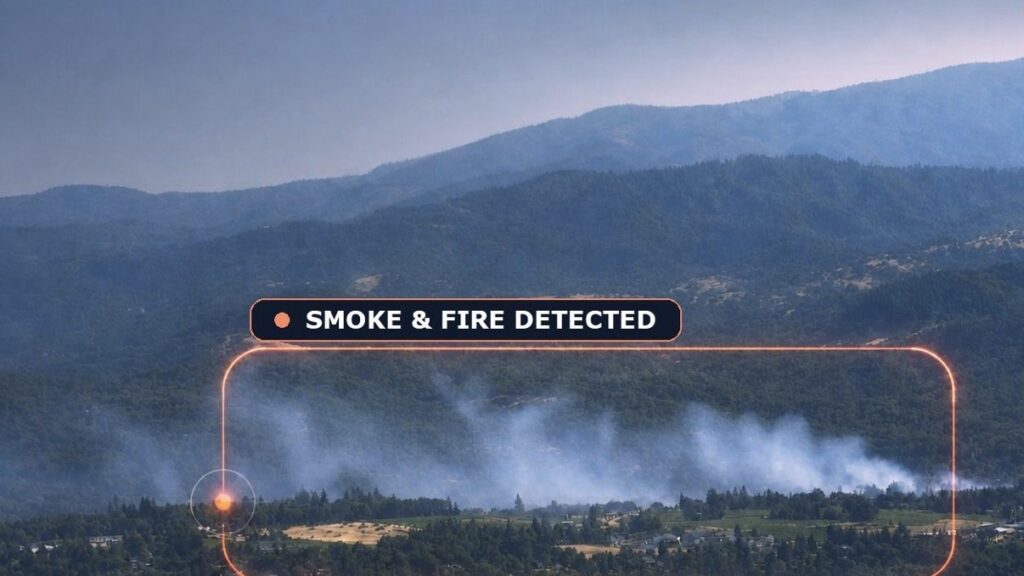
The deployment choice is a real decision, and it is simpler than vendors make it sound.
| Factor | Edge or on-premise | Cloud |
|---|---|---|
| Latency | Very low, on site | Depends on the network |
| Privacy and retention | Local control | Centralized, needs strict controls |
| Resilience | Runs if the connection drops | Requires connectivity planning |
| Model updates | Device by device | Centralized and fast |
Either way, the job description is the same. The AI does the watching. People do the deciding. Getting that division of labor right is the whole game. It is exactly where part of the industry has started getting it wrong.
Is the Industry Automating Backwards?
A pattern worth naming: some AI vendors are standing up their own in-house monitoring floors. Every detection routes through the vendor’s staff before anything reaches the customer. It is marketed as human verification. Structurally, the AI company has inserted itself as the monitoring provider, and the customer inherits three problems. The central stations and integrators who built and earned the monitoring relationship get pushed aside. Response now depends on one vendor’s staffing and capacity, instead of the redundant networks the industry spent decades building. And the alert backlog does not disappear. It just moves from your team to theirs.
There is a structural reason the two paths diverge. When the AI ships in the box, the company is forced to improve detection release after release, because nuisance alarms land on the customer and the market punishes them. When the vendor layers its own monitoring floor over the technology, that pressure disappears. Bodies absorb the false alarms, and the technology can sit still.
Scylla, an independent member of the ASPP™ Community of Experts, has taken the opposite position publicly. It is a technology company that builds the detection and hands verified events to the monitoring provider or the customer’s own team. The events land inside the workflow those operators already trust. Their argument, in their own words at scylla.ai, is simple. The job is to strengthen the security industry, not to quietly compete with the people in it. We think that is the right architecture, and not because of who says it. Automation that reinserts a mandatory human bottleneck in front of every alert is not automation. It is yesterday’s monitoring model wearing an AI badge.
How Should an Alert Actually Reach a Human?
Prioritized, routed, and verified at the decision point rather than re-watched from scratch. Picture the difference. A camera with weapons detection sees a person approaching a door with a visible firearm. In the old model, that image waits for whoever happens to be looking at monitor fourteen. In the prioritized model, the system pushes a high-priority notification within seconds to the people who can act. On-site security, designated staff, and the organization’s monitoring partner all get it at once, with the frame attached. Lower-confidence events arrive as medium or low priority. A person spends judgment where judgment matters, instead of spreading attention across everything equally.
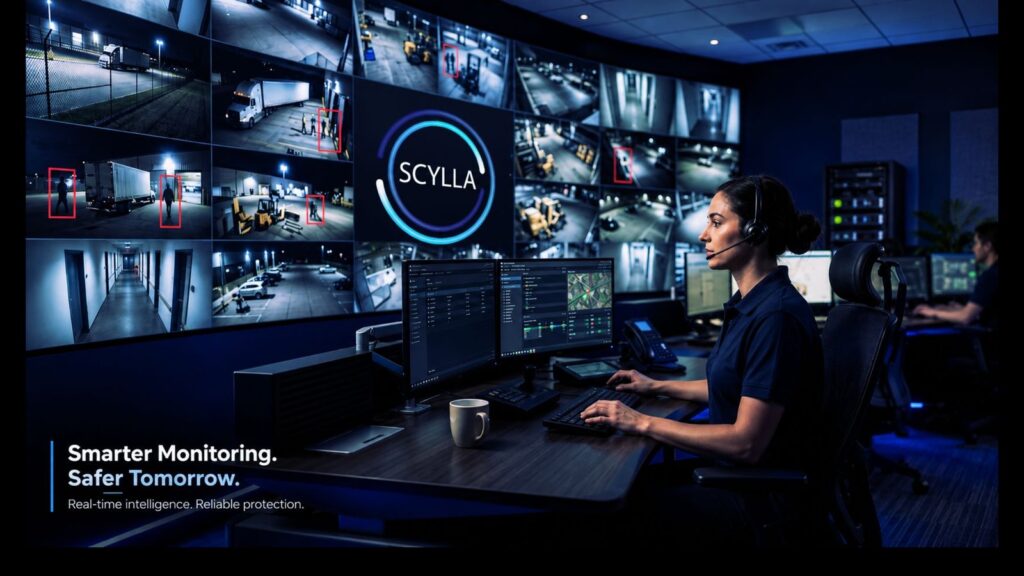
The human stays in the loop, in the right place in the loop. The job becomes verifying a scored event and making the call. Nobody serves as the sole detector for a hundred screens. That is what closes the distance between detection and action, the same gap we examined in eliminating the gap between detection and police response. It is the difference between a notification that starts a lockdown and footage that explains one.
Why Does AI-Powered Surveillance Still Make Mistakes?
Because it is software looking at the physical world. Lighting, angles, occlusion, and edge cases produce false positives and missed detections, and models drift if nobody validates them. An honest program plans for that. It calibrates against the site’s real conditions, keeps audit logs for every alert and action, and puts human verification exactly where the last section put it. We have watched this technology mature firsthand, including testing AI gun detection at a Department of Defense installation. The pattern is consistent: the systems get better. The organizations that benefit are the ones that governed them honestly, instead of advertising them as omniscient.
The mistakes are not a reason to keep the camera wall. They are the reason the human stays in the loop at all. Independent public benchmarking, like the computer-vision leaderboard we wrote about in our look at the global leaderboard, is how buyers should evaluate vendors. The standard is published, third-party, and verifiable, never a brochure claim.
Where Does AI-Powered Surveillance Fit a Prevention Program?
Detection technology buys time, and prevention is what the time is for. In the P.R.O. Model™, AI-powered surveillance sits inside a larger system. An assessment determines where detection matters most. Hardened pathways slow an attacker down. A trained population notices and reports, and a practiced response stands ready for the day the earlier layers are tested. Remove those layers and the smartest camera in the world is just a faster witness.
That system view is the work of Chris Grollnek, an active shooter expert whose prevention-first model the DOJ selected twice. It is why our guidance on technology, mapping and detection starts with the program and ends with the purchase order, never the other way around.
Frequently Asked Questions
Does AI-powered surveillance replace security staff?
No. It replaces the impossible part of the job, staring at a monitor wall. It upgrades the human role to verification and decision-making on prioritized events. People remain the point of the system.
How many cameras can one operator effectively monitor without AI?
Far fewer than most deployments assume. Federal and peer-reviewed research on vigilance shows sustained attention declining within the first half hour of a watch, regardless of experience. The honest answer is that human-only monitoring does not scale. That is the problem analytics exist to solve.
Should the AI vendor also be the monitoring provider?
We would ask hard questions first. Routing every alert through the vendor’s own floor concentrates your response on one company’s staffing. It also displaces the monitoring partners who know your account. The architecture we favor delivers verified, prioritized events into the monitoring relationship you already have. That can be on site or at your central station.
A camera will always be a truthful witness. The organizations that stay ahead of this threat are the ones that stopped settling for testimony. Prepared, not scared. Destination #NEVERHERE™.
Share this article

Written by : Chris Grollnek
International Public Speaker | Media Contributor
Active Shooter Expert Chris Grollnek, M.S. has over 35 years of experience in the study and application of protective measures in the military, police, and special purpose contracting. Former U.S. Marine and retired police detective corporal.
As Chairman of the Board & Founding Principal of the Active Shooter Prevention Project (ASPP™), LLC, Chris Grollnek is recognized for his work on the phenomenon of active shooter incidents.
Latest articles
November 6, 2026
November 6, 2026
November 6, 2026