Active Shooter Prevention Services: The Questions Buyers Ask Before They Hire ASPP™
By Active Shooter Prevention Project, LLC (ASPP™), a service-disabled veteran-owned small business. Published October 18, 2026.
Active shooter prevention services are the assessments, training, policies and technology choices that stop an attack before it starts, delivered in an order that holds up on the worst day. ASPP™ provides them on the P.R.O. Model™, Prevention, Response, Options, in that order. The U.S. Department of Justice selected that model as “A” national standard for the Assistant United States Attorneys and across the Department, for 2022 to 2025 and again for 2026 to 2030, and it is in use at some installations and commands across the Department of Defense. The U.S. Army’s own account of an AI security test at Blue Grass Army Depot names Chris Grollnek, Chairman of the Board and Founding Principal of ASPP™, as one of the country’s foremost authorities on active shooters. His work is also profiled by GSIS, where he serves as a senior advisor, and by Crisis Response Leader Training, a member of the ASPP™ Community of Experts. We have been operating since 2010, and the U.S. Small Business Administration certifies us as a service-disabled veteran-owned small business. The first conversation is also free. In short, the answers below are the ones a superintendent, a pastor, a facilities director, a chief or a contracting officer asks us in that first call.
What active shooter prevention services does ASPP™ actually deliver?
Four things, and they fit together. First, we assess buildings and the people in them, so the gaps are found before an attacker finds them. Second, we train leaders, staff and responders to one picture, from a two-hour executive briefing to a full-scale exercise. Third, the policy: we write it, and then we build the threat assessment team that turns a worried comment into a handled case. Finally, we map the technology, what the building already owns and what it is missing. That map comes through a Community of Experts that spans access control, weapons detection, AI video analytics, ballistic glass, indoor drone response, gunshot detection and 911 integration.
The problem most clients bring us is a locked front door and a nagging feeling. The impact of leaving it alone is that the feeling is usually right. The solution is a plan with a price on every line. As a result, the building earns time, and the staff knows what to do with it.
What is the P.R.O. Model™, and why does the order matter?
Prevention, Response, Options. Most of the industry starts at response, because response is easy to sell and easy to film. We start at prevention instead, because prevention is the only part of this problem that can end with an ordinary Tuesday. Prevention is the behavioral threat assessment and the physical assessment. It is also the risk management review with a cost and a consequence on every finding, the HR procedures, and the reporting channel with an owner.
Response is React, Escape, Survive, taught beside Run, Hide, Fight and Avoid, Deny, Defend so every person recognizes the call under any system. Options are the layers the Community of Experts brings, so that a building has more than one way through every moment. Three documented saves sit behind that order, so the order is not a theory. The full description of the P.R.O. Model™ and the record of the Department of Justice selection are both public.
Who hires ASPP™?
School districts and universities. Houses of worship. Hospitals and clinics. Stadiums and arenas, where our Chairman served as the NFL’s Active Shooter Prevention Coordinator for Super Bowl LVIII and LIX. NBA and NHL venues have also brought us in for facility assessments. Corporations from fourteen Fortune 100 companies down to a shop with nine employees and one front door. Cities, counties and states.
Federal agencies hire us too. For the Department of Justice we created the P.R.O. Model™ and the National Active Shooter Prevention Training Video for 10,700 Assistant United States Attorneys. For the Defense Nuclear Facilities Safety Board we wrote the Program of Instruction. In every case the common thread is a leader who signs off on a safety budget and wants it spent in the right order.
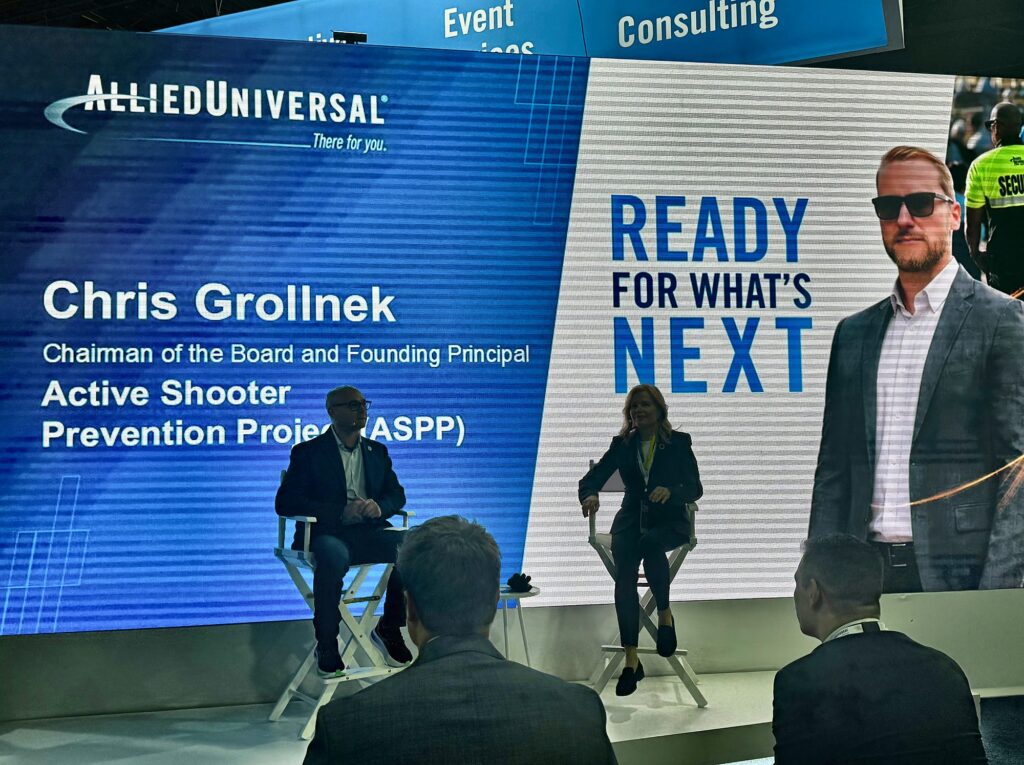 Chris Grollnek on the Allied Universal speaker stage at GSX 2026, Atlanta, September 2026.
How does an active shooter vulnerability assessment work, and what do we get?
We walk the building the way an attacker would and the way a response team would. We do it door to door, with the people who run it. Then we read the policies, the drills, the reporting channel and the technology that is already installed. You get a written report that lists every finding, with the cost to fix it set against the cost of the day it fails, in priority order. It is written so a board, a grant writer or a contracting officer can act on it without a translator. Most clients then fund the plan in order over a year or two, and the first items are usually the cheapest. The assessment page covers the scope in detail, and for congregations the house of worship page explains how the assessment feeds a Nonprofit Security Grant Program application.
What does active shooter prevention training look like?
It depends on who is in the room, because active shooter prevention training has to fit the people taking it. Leaders get an executive briefing that ends with decisions made on paper before anyone needs them. Staff get the P.R.O. Model™ workshop, built for repetition, and learning management system delivery covers the people who missed the day. Meanwhile, responders and command teams get tabletop simulation and full-scale exercises, with the local police and fire departments in the building. The workshops page lists the formats. We do not do fear. Prepared, not scared, live without worry.
How much do active shooter prevention services cost?
Less than the alternative, and we can prove it line by line. An assessment is scoped to the building and the people in it; a workshop is scoped to the headcount; a full-scale exercise is scoped to the agencies in the room. We give a number after the first conversation, and the first conversation is free.
Two things also make the budget easier than most buyers expect. First, grants fund active shooter prevention services. The FEMA Nonprofit Security Grant Program covers houses of worship and other nonprofits, and the Department of Justice STOP School Violence program covers districts, states, tribes and police departments. Both pay for exactly the assessments, training and threat assessment teams we deliver. Second, cooperative purchasing vehicles let a public agency buy without a full open solicitation. The price to solve a problem is far less than the cost of dealing with one.
Can a federal, state or local agency buy from ASPP™ without a full solicitation?
Yes, three ways. First, ASPP™ is certified by the U.S. Small Business Administration as a service-disabled veteran-owned small business and a veteran-owned small business, so a federal buyer can use an SDVOSB set-aside or a sole source award. Second, we are available through established cooperative purchasing vehicles, including OMNIA Partners, Sourcewell, NACo and NASPO ValuePoint. So a city, county, school district or state can buy on a contract that has already been competed. Third, a prime contractor holding a federal contract with a small business subcontracting plan can count a subcontract to ASPP™ toward its SDVOSB goal. The capability statement carries the UEI, CAGE code, NAICS codes and contract numbers.
How is ASPP™ different from a response-only training company?
The response programs most people know, Run, Hide, Fight, ALICE, CRASE, Avoid, Deny, Defend, teach people what to do after the first shot, and the good ones do it well. We teach them too, inside Response, because we respect the people who built them.
The difference is where we start and who we bring. We start with prevention, because the attack that never happens is the only outcome with nothing to recover from. Then we bring a Community of Experts, more than sixty practitioners and partner companies with more than 800 years of combined experience, so a client is never buying one person’s opinion. Our Chairman was also on scene at an active shooter incident, and the model exists because of what that day taught him. Our 2026 buyer guide to active shooter prevention training programs compares the approaches openly.
What happens in the first ninety days?
Week one, the first conversation about active shooter prevention services, free, usually thirty minutes. Weeks two through six, the assessment and the written plan. Weeks six through twelve, the leadership briefing, the first staff workshop and the threat assessment team stood up with a policy behind it. By day ninety most clients have closed the gaps that cost almost nothing and funded the next three in order. They have also rehearsed the day they hope never comes. After that we sustain it with an annual re-assessment, refresher training and an exercise, so the standard holds after the consultants leave.
Frequently asked questions
What are active shooter prevention services?
The assessments, training, policies and technology choices that stop an attack before it starts. In practice that means a behavioral and physical threat assessment of the building and the people in it, and a prioritized plan with a cost on every line. It also means training for leaders, staff and responders, a threat assessment team with a policy behind it, and the layered technology that gives a building more than one option.
Who is ASPP™?
Active Shooter Prevention Project, LLC is a service-disabled veteran-owned small business in North Richland Hills, Texas, operating since 2010. It is led by Chris Grollnek, a Former U.S. Marine and retired police detective corporal and the creator of the P.R.O. Model™.
Is the P.R.O. Model™ a national standard?
The U.S. Department of Justice selected it as “A” national standard for the Assistant United States Attorneys and across the Department, for 2022 to 2025 and 2026 to 2030, and it is in use at some installations and commands across the Department of Defense.
How long does an active shooter vulnerability assessment take?
Most buildings are walked in one to three days and the written plan follows within a few weeks; a district or a campus with many buildings is scheduled in phases.
Can grant money pay for this?
Yes. The FEMA Nonprofit Security Grant Program funds assessments, planning, training and exercises for houses of worship and other nonprofits. The Department of Justice STOP School Violence program funds training and threat assessment teams for districts, states, tribes and police departments. In both cases the assessment is the document the application is built on.
Does ASPP™ work outside Texas?
Yes. We work in all fifty states and the District of Columbia, and the Community of Experts has delivered across 26 states and four countries.
How do we start?
Email chris@aspppro.com or call 214-663-2849 and tell us what you are trying to protect. The first conversation is free, so you lose nothing, and you will leave it with the first three things to fix.
Fact sheets you can download and pass along: the ASPP™ capability statement, the glass solution fact sheet, the ASPP™ white paper and the workplace violence prevention during layoffs one-sheet. Destination #NEVERHERE™.
If the question is how a school district, county or agency actually purchases any of this, we have written that out in full: how to buy active shooter prevention, including which cooperative and federal contract vehicles apply to which kind of organization, and who makes each item in the catalog.