The technology is ready. Defense procurement is not. That was the honest takeaway from three days at the 29th Space and Missile Defense Symposium in Huntsville, Alabama, 11 to 13 August 2026. Chris Grollnek, Chairman of the Board & Founding Principal, was there among more than 9,000 attendees. We are grateful to have been in the room.
A last keynote, and what was in it
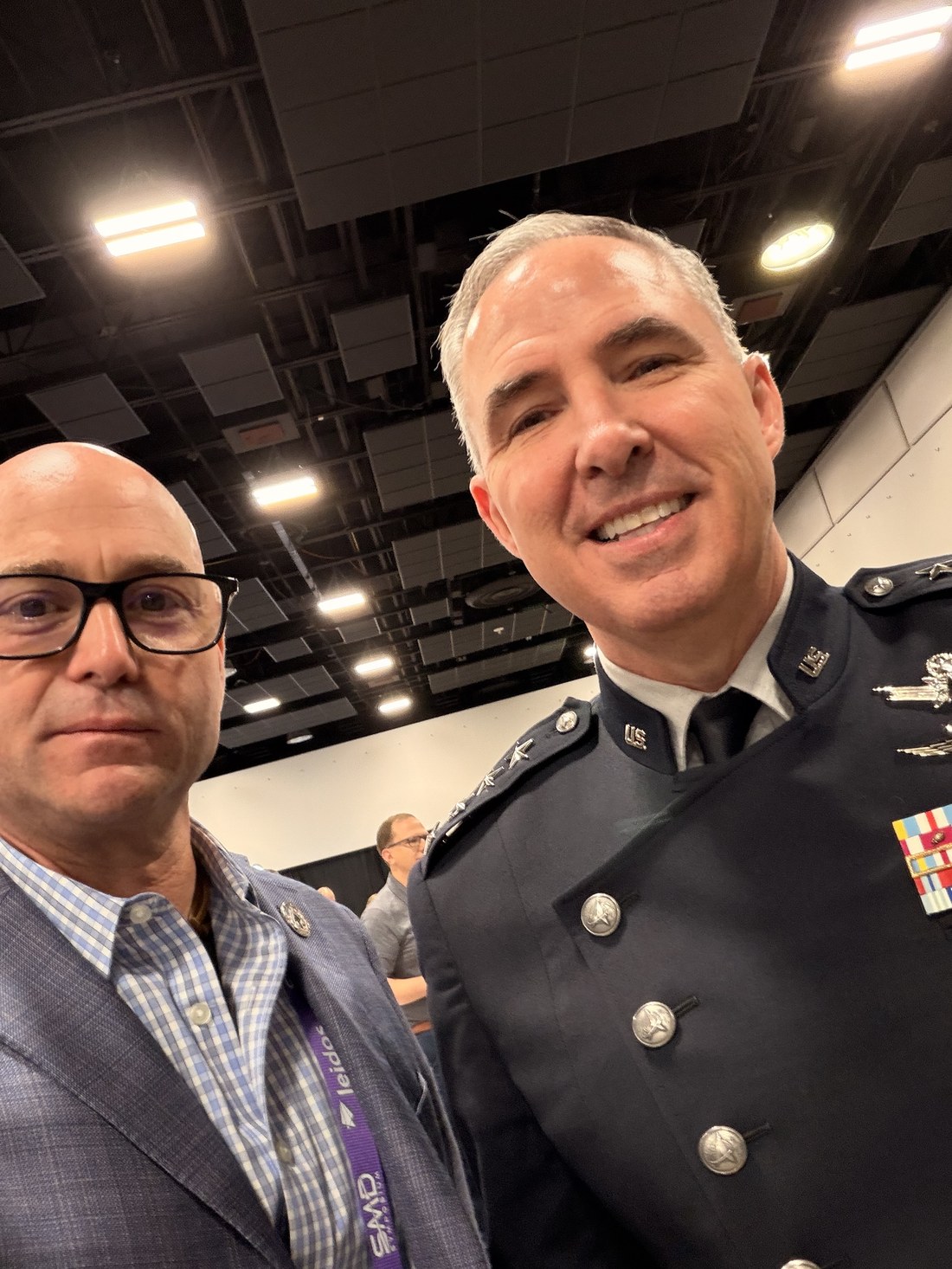
General Stephen N. Whiting delivered the SPACECOM Update on Wednesday morning. It was his final keynote as Commander, U.S. Space Command, a fact reported at the time by Aviation Week.
He did not spend it on legacy. He spent it on what the country needs to be able to do next. Two priorities led his list: acting against adversary systems in a coordinated way, and dealing with the very large satellite constellations other nations are now placing in low orbit.
One detail matters, because people in that world notice it immediately. General Whiting commands U.S. Space Command, which is a combatant command. He does not command the U.S. Space Force, which is a service. Both wear the same uniform, which is exactly why the mistake is common.
What is defense procurement, in plain terms?
It is buying. Buying aircraft, buying software, buying training, buying a service.
Two rulebooks govern it. The Federal Acquisition Regulation, called the FAR, is what every federal buyer follows. DoD 5000 is the companion process for major defense systems.
Both exist for good reasons. Public money should be spent carefully. But a defense procurement rulebook built over decades to prevent waste also prevents speed, and speed is now the safety problem.
The future is not coming. It is already here.
That was the real feeling in the room. Not a forecast. A deadline.
The capabilities being discussed are fielded or nearly fielded. The threats are current. What lags is not the technology and not the people. It is the speed at which a good answer is allowed to reach the person who needs it.
A departing commander spending his last keynote on the next five years, rather than the last five, is its own kind of message.
What actually changed in defense procurement in 2026
| Change | Plain English |
|---|---|
| Executive Order 14275. First 12 proposed rules issued 23 June 2026, across 17 FAR parts | The buying rulebook is being rewritten. Biggest rewrite in over forty years a |
| Shift to portfolio-based management | Money grouped around a mission instead of one product at a time |
| Program Executive Officers replaced by Portfolio Acquisition Executives. Army 6, Navy 9, Space Force 9, and the Air Force redesignated all of its PEOs effective 4 July 2026 | One accountable person owns a mission portfolio, with requirements, budget authority and the contracting workforce underneath them |
| Commercial-first determination | Before buying custom, a buyer must write down that nothing commercial exists that would work |
| FY2026 NDAA Section 1826 | Small and nontraditional companies exempted from FAR Part 31 cost principles and certified cost or pricing data b |
Source: ASPP™ review of the Federal Register and Congress.gov, as of 15 August 2026.
a Proposed rules are not final rules. Schedules move.
b Exemptions lower paperwork barriers. They do not hand anyone a contract.
The two memos behind the change
The table above describes outcomes. The instructions that produced them are public documents, and both are worth knowing by name.
6 March 2025, Directing Modern Software Acquisition to Maximize Lethality. This directed components to treat the Software Acquisition Pathway as the preferred route for the software portions of business and weapon system programs, and named Commercial Solutions Openings and Other Transactions as the default approaches for soliciting and awarding under it. The Federal Acquisition Regulation route did not disappear. It stopped being the assumption.
7 November 2025, Transforming the Defense Acquisition System into the Warfighting Acquisition System. The Defense Acquisition System was redesignated the Warfighting Acquisition System. The Joint Capabilities Integration and Development System, the requirements process, was disestablished and replaced with a framework built around Key Operational Problems and Mission Engineering and Integration Activities. The organizing principle stated throughout is speed to capability.
Requirements, budget authority and the contracting workforce now sit under one accountable person. That is not a paperwork change. That is the buyer reorganizing itself around speed, in public, on a published timeline, while much of the industry that sells to it carried on preparing the packages it prepared in 2019.
Why a prevention company reads acquisition memos
Because in this work the two stopped being separate a long time ago.
Technology now expires faster than institutions can field it. A capability that takes four years to procure can arrive obsolete on the day it is installed, and an obsolete prevention capability is not a neutral outcome. It is a gap somebody eventually walks through.
That is why acquisition belongs in a conversation about prevention. The speed at which an organization can buy and field a protective capability is now part of its threat picture. A leader who reads the room but cannot read the environment their organization buys in is watching the car ahead and never checking the mirror.
Four questions worth asking, whatever you are responsible for:
- What authority was your protective capability bought under, and what does that authority let you change later?
- How long did your last protective technology take to field, and did the threat wait?
- Who in your organization watches policy, and do they talk to the people watching threat?
- What does your prevention program do on the day the technology fails? That answer tells you whether you have a program or a purchase.
The line that matters most to a small company
A buyer now has to put in writing that no commercial product or service exists that could meet the need, before spending public money building a custom one.
Turn it around. If the capability already exists commercially, the buyer must account for why they did not use it. In effect, the Pentagon now has to prove on paper that a company like ours does not exist.
That is not a sales pitch. It is a written obligation, and it is new.
So why do good answers still go unseen?
Because rules change faster than habits do.
Procurement officers are careful people, and being careful has been rewarded for thirty years. Nobody was ever promoted for taking a chance on an unfamiliar vendor. The safe move has always been to buy the thing you bought last time, from whoever sold it to you last time.
ASPP™ has run into this directly. The P.R.O. Model™ is in use at some installations and commands across the Department of Defense. That does not mean every unit knows it exists. A standard can be adopted at the top and stay invisible three doors down, because the buying process does not carry the news.
The best defense was always the point
The Department of Defense is extraordinary at responding. When the country asks, remarkable people do remarkable things, and they have earned every bit of the respect they get for it.
But the institution has always known something else. The best offense is a good defense. You do not win by being fastest to the fire. You win when the fire never starts.
That is exactly what the P.R.O. Model™ is. Prevention, Response, Options, in that order. Prevention first.
The P.R.O. Model™ was selected by the U.S. Department of Justice as “A” national standard for the Assistant United States Attorneys and across the Department for active shooter prevention, first for the 2022–2025 cycle and again for 2026–2030. The P.R.O. Model™ is also in use at some installations and commands across the Department of Defense.
Why prevention keeps losing the budget fight
Because of how things get counted.
Prevention is a capability, not a platform. A platform is a thing. You can photograph it, put a serial number on it, and point at it in a hearing. A capability is an outcome, and nobody can photograph an attack that never happened.
So buyers reach for the only tool that makes an outcome look countable: a risk calculation. The same arithmetic an actuary uses to price a loss before it occurs, applied to a purchase order. How likely, how costly, how much is it worth spending to avoid it.
That math has its place, and it is also how prevention loses. A risk model rewards what has already happened often enough to carry a number. The entire point of prevention is the event with no number, because it did not occur.
A procurement officer with vision does not have to wait for a formula to tell them what a life is worth. They can decide how safe a place ought to be and buy that. Portfolio funding finally lets them, because money grouped around a mission can pay for an outcome instead of an object.
What we would ask of a procurement officer
Three things. None require a new budget line.
One. When you write the commercial-first determination, actually look. The search is the requirement.
Two. Ask for outcomes rather than objects. Write the requirement as what must not happen, and let the market answer it.
Three. Treat a standard already adopted by your own department as evidence, not as the starting point for a fresh evaluation.
None of that is a favor to any company. It is the rulebook as it now reads.
Our tagline is not decoration. We make doing business easy by transforming complex challenges into clear, efficient solutions. It exists because the hardest part of this work has never been the prevention. It has been getting through the door.
Thank you
To the organizers of the Space and Missile Defense Symposium, to a commander who spent his last keynote on the future rather than the past, and to everyone who has put ASPP™ in rooms we did not expect to be in. These are the rooms we get to participate in, and we do not take one of them for granted.
This is one of two pieces from the 2026 Space and Missile Defense Symposium. The companion covers Golden Dome, General Michael Guetlein, and why it took a presidential directive to move information the government already owned.
#NEVERHERE™ is the destination. The P.R.O. Model™ is how we get there.
The P.R.O. Model™ · DOJ Recognition · Request a consultation
Share this article

Written by : Chris Grollnek
Active Shooter Expert Chris Grollnek (#activeshooterexpert) is a Former U.S. Marine and retired police detective corporal, the Chairman of the Board and Founding Principal of the Active Shooter Prevention Project (ASPP™), and the creator of the P.R.O. Model™, Prevention. Response. Options. Selected by the Department of Justice as "A" national standard for the Assistant United States Attorneys and across the department, and in use at some installations and commands across the Department of Defense. He is an international public speaker, trainer, educator, writer and director who has appeared in numerous documentaries, and he provides consulting to Fortune 500 companies and special events. Grollnek has testified about the terrorism and counterterrorism training needs of the United States before House Ways and Means, and in Senate testimony convened by Sen. Kay Bailey Hutchison in the Hart Senate Office Building in 2002. Ahead of that testimony, the Center for Strategic and International Studies (CSIS) in Washington, D.C. invited him to brief Ph.D. and senior executive staff of the U.S. Government on subterranean training, complex curriculum development and public lectures.
Latest articles
November 6, 2026
November 6, 2026
November 6, 2026