
By Chris Grollnek, Active Shooter Expert
Avoid, Deny, Defend is one of the most widely taught active shooter response frameworks in the country, and it deserves its reach. Developed through the ALERRT Center at Texas State University and adopted by agencies nationwide, and delivered to civilians as CRASE training, it gives people three clear decisions once a threat is moving: get away if you can, keep the threat out if you cannot, and fight as the last resort. We credit it fully. And the question we build our work around begins where that guidance ends: what about the weeks before there is anything to avoid?
The Department of Justice selected the P.R.O. Model™ as “A” national standard for active shooter prevention for 2022 through 2025 and again for 2026 through 2030. Prevention is the half of this problem that no response framework was built to carry, and it is the half most organizations have never built.
What Does Avoid Deny Defend Actually Teach?
The framework orders a person’s options by survivability. Avoid asks you to know your exits and put distance between yourself and the threat the moment one appears. Deny asks you to control access, lock and barricade, turn out lights, and make your space a harder problem than the next one. Defend acknowledges that when the first two are gone, aggression with total commitment beats hesitation. Taught well, it is memorable under stress, and that is exactly what response guidance has to be.
Its designers were honest about its scope, and the scope is the point. Every branch of the decision tree assumes a threat you can already see, hear, or reasonably suspect. The framework activates at awareness. Nothing in it speaks to the weeks before awareness, because that was never its job.
Where Does Avoid Deny Defend Stop?
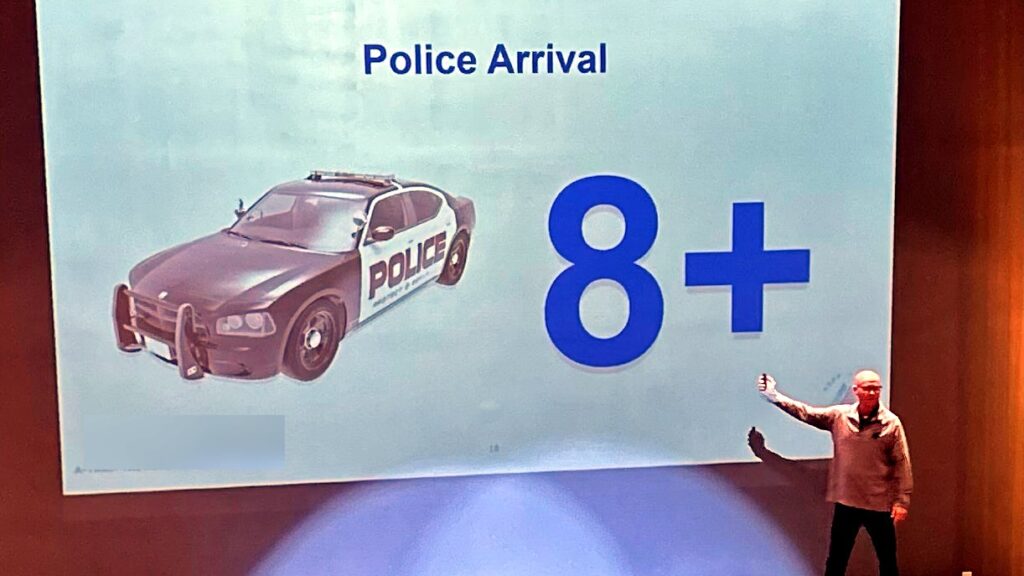
At the same line every response model stops, a line we walked through in detail in our examination of Run, Hide, Fight and again in our look at ALICE training, and in our look at A.L.I.V.E. training. A response begins when danger becomes visible. The FBI’s research says the danger was visible earlier, just not to responders: active shooters typically display four to five observable concerning behaviors in the weeks and months before an attack, seen by coworkers, classmates, family, and friends.
“Avoid” is the earliest word in the framework, and even it starts too late for that window. You cannot avoid a threat no one has assessed, deny entry to a pathway no one has hardened, or defend against a trajectory no one was trained to notice. The decisions that most change the outcome were available before the framework’s first branch ever applied.
None of that is a criticism of Avoid, Deny, Defend. It is a definition of what a response model is, and the organizations that get this right treat the framework as the last layer of a system rather than the system itself.
What Belongs Before Avoid Deny Defend?
A prevention program, built in the order the risk actually develops. It starts with a qualified assessment, because you cannot harden a pathway you have not mapped; we laid out that case in why assessments matter. It continues with training the population to notice and report concerning behavior, and it routes those reports into a behavioral threat assessment process that can tell a bad day from a real trajectory. When that system exists, the community becomes the earliest sensor an organization has, working in the window Avoid, Deny, Defend was never designed to reach.
That is the order the P.R.O. Model™ enforces: Prevention first, Response prepared, Options preserved. Response training stays essential, and most organizations need more of it, not less. It simply performs better on a prevention basis, a case we made across the other side of public safety.
How Do the Two Halves Work Together?
Cleanly, because they never compete for the same minutes. Prevention owns the weeks: assessment, hardening, noticing, reporting, and early intervention. Response owns the moment: the practiced decisions of Avoid, Deny, Defend, or of our own React, Escape, Survive methodology, ready for the day prevention is tested. An organization that funds both is not buying the same protection twice. It is covering both halves of a timeline that has always had two halves.
The work of Chris Grollnek, an active shooter expert whose prevention-first model the DOJ selected twice, exists to build the half that response frameworks leave open by design.
Frequently Asked Questions
Is Avoid Deny Defend wrong?
No. It is sound, widely adopted response guidance from the ALERRT Center at Texas State University, and taught well it saves lives. It is a response framework, which means it begins at threat awareness. Prevention is the separate, earlier layer, and the two belong together.
What is the difference between Avoid Deny Defend and Run Hide Fight?
They are parallel frameworks teaching the same survivability logic in different language, one from the ALERRT Center, one popularized by DHS and the FBI. Both begin once a threat is present, and both share the same starting line: neither reaches the warning window before an attack.
What should come before Avoid Deny Defend?
A prevention program: a qualified assessment, hardened pathways, a trained population that notices and reports, and a behavioral threat assessment process that acts early. That is the structure of the P.R.O. Model™, selected by the DOJ as “A” national standard for 2022 through 2025 and 2026 through 2030.
Avoid, Deny, Defend earned its place in the response half. The outcome of an attack, though, is usually shaped in the weeks before its first branch ever applies. Prevention is the work of those weeks. Prepared, not scared. Destination #NEVERHERE™.
Share this article

Written by : Chris Grollnek
Active Shooter Expert Chris Grollnek (#activeshooterexpert) is a Former U.S. Marine and retired police detective corporal, the Chairman of the Board and Founding Principal of the Active Shooter Prevention Project (ASPP™), and the creator of the P.R.O. Model™, Prevention. Response. Options. Selected by the Department of Justice as "A" national standard for the Assistant United States Attorneys and across the department, and in use at some installations and commands across the Department of Defense. He is an international public speaker, trainer, educator, writer and director who has appeared in numerous documentaries, and he provides consulting to Fortune 500 companies and special events. Grollnek has testified about the terrorism and counterterrorism training needs of the United States before House Ways and Means, and in Senate testimony convened by Sen. Kay Bailey Hutchison in the Hart Senate Office Building in 2002. Ahead of that testimony, the Center for Strategic and International Studies (CSIS) in Washington, D.C. invited him to brief Ph.D. and senior executive staff of the U.S. Government on subterranean training, complex curriculum development and public lectures.
Latest articles
November 6, 2026
November 6, 2026

November 6, 2026