The Other Public Safety
A national standard for active shooter prevention.
A national standard for active shooter prevention is a measurable framework that tells an organization, an underwriter, or a superintendent whether prevention is being done well before a shooter ever appears. It is different from response training. It is different from emergency preparedness. It measures what happens on ordinary Tuesdays, not what happens in the fifteen minutes after an alarm sounds.
The response side of public safety has frameworks recognized by the country. NFPA 3000 gave incident commanders a common structure. ALERRT trained a generation of officers to move toward the threat. Run·Hide·Fight gave civilians a shared language. Each of those frameworks saved lives.
The prevention side has no equivalent. That gap is what the Active Shooter Prevention Project has spent fifteen years closing, and it is what the P.R.O. Model™ was built to measure.
The response frameworks that got us here
For two decades, the American approach to active shooter incidents has been response-optimized, and honestly, response-optimized well. NFPA 3000 stitched together fire, EMS, and law enforcement into a single operational picture that jurisdictions can plan against. ALERRT put a generation of patrol officers through single-officer, direct-to-threat training that changed how the first five minutes of an incident actually look on the ground. Run·Hide·Fight put a memorable phrase in the vocabulary of tens of millions of civilians who now have some idea of what to do when the worst arrives.
Each of these frameworks earned its recognition. We use them, we teach alongside them, and we credit them. What we also see, after fifteen years of doing this work and being selected twice by the U.S. Department of Justice (2022-2025 and 2026-2030) to help build a national prevention framework, is a ceiling.
Where response meets its ceiling
The ceiling is straightforward: every response framework activates after an incident begins. That is by design, and it is the correct design for the problem those frameworks were built to solve. But it means the entire national conversation about active shooter safety has been optimized for the fifteen minutes after the first call, leaving the previous fifteen months of warning signs, preventable failures, and unmeasured vulnerabilities largely unaddressed.
Ask an underwriter to compare the prevention posture of two school districts, and you will get two self-reported questionnaires, with no common yardstick for the answers. Ask a superintendent to prove their prevention program is any better today than it was last year, and you will get an anecdote, not evidence. Ask a broker why one insured deserves better terms than another, and the honest answer is that they cannot tell you.
The gap no framework has closed
For a century, insurance has known how to reward prevention. Fire protection was standardized because the industry agreed on what good prevention looked like and gave organizations a way to prove it. Public Protection Classification codified it. Sprinkler credits followed. Loss ratios came down.
Active shooter risk has not had that agreement. Coverage exists. Prevention resources exist. What is missing is a shared standard that says: this is what measured prevention looks like, this is how you demonstrate it, this is how you reward it.
A national standard for active shooter prevention, measured
The P.R.O. Model™ is the framework built to close that gap. Prevention. Response. Options. Five layers, each with a methodology component that ASPP™ owns and a partner-technology component drawn from a vetted ecosystem.
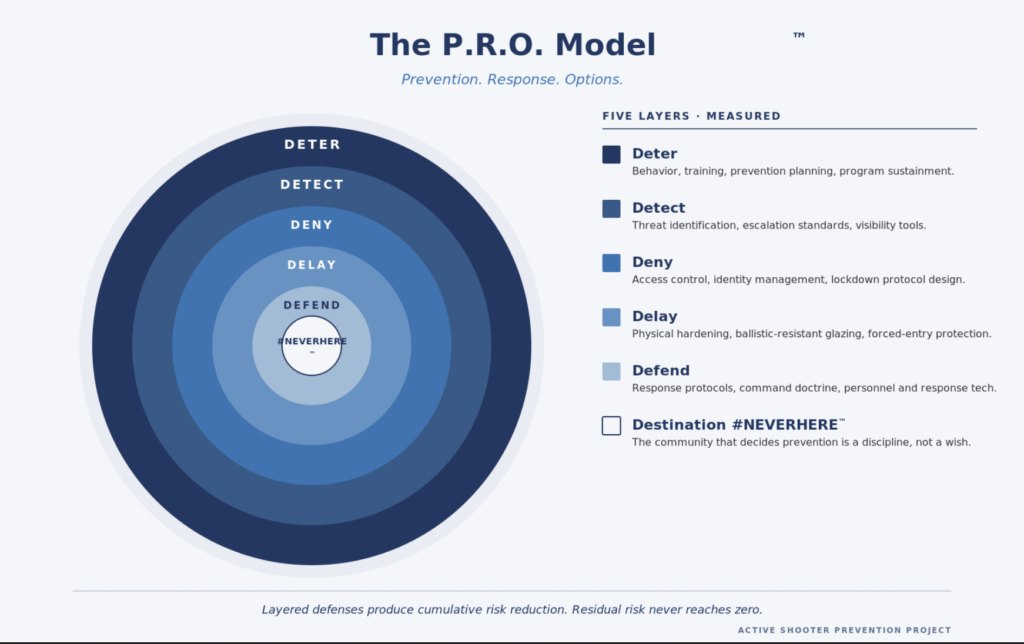
The P.R.O. Model™ prevention measured, layer by layer.
Deter measures whether an organization has moved offenders’ calculus before they choose a target. Behavioral training, prevention planning, program sustainment, and visible assessment are reflected in a Deter score.
Detect measures what an organization sees before an incident starts. Threat identification protocols, escalation standards, and the physical and digital tools that make hidden risk visible.
Deny measures the operational integrity of the environment. Access control, identity management, and lockdown protocol design that turn “the building was open” into “the building responded.”
Delay measures how much time the environment buys the people inside. Physical hardening, ballistic-resistant glazing, and forced-entry protection.
Defend measures how command and control performs when everything else has been tested. Response protocols, security personnel providers, and autonomous response technologies.
None of these layers reduces risk to zero. That is not the point. Layered prevention reduces cumulative risk, and the residual risk measured is the risk that can be priced, improved, and renewed.
What a standard actually does
A standard does three things a questionnaire cannot.
First, it gives an underwriter something to price against. When two accounts arrive on the same desk and one carries a completed P.R.O. Model™ Assessment showing layer-by-layer measurement, the underwriter has a common yardstick that a self-reported questionnaire does not provide. That produces better risk selection, more consistent decisions across a book, and a defensible answer when a rate filing gets challenged.
Second, it gives a Chief Security Officer a way to walk into the Principal’s office or the Superintendent’s meeting with a plan that improves over time. Not a promise, not fearmongering, and not a product sold to the wrong buyer. A layer at a time, with visible improvement in the layer measured.
Third, it gives the community a way to compare. Not to shame the districts behind, but to pull them forward. Fire safety came out of the same logic. Prevention that is measured is prevention that improves.
The Active Shooter Prevention Project has spent fifteen years and two DOJ engagements building this framework so the country finally has an answer when someone asks: “How effective is this organization’s active shooter prevention program?”
Where to start, by sector
The path in is the same in every setting: a P.R.O. Model™ Assessment delivers a layer-by-layer read on where an organization sits today, names the highest-return improvements first, gives leadership the vocabulary to move a budget, and gives the insurer documentation to reward the improvement. What changes is the pressure each sector is under.
Active shooter training for schools
Schools carry the heaviest expectation and the thinnest margin. The assessment maps directly to grant eligibility under the SAFE School Act and related legislation, which means the finding that identifies a gap is often the same document that funds closing it. Prevention work in a school also has to survive the calendar — staff turnover, new students every year, drills that must inform rather than frighten. A district does not need one heroic training day. It needs a repeatable model its own people can run in year three without us in the room.
Active shooter training for businesses and workplaces
For employers the conversation now has two drivers at once: duty of care, and a compliance clock that started with California SB 553 and is spreading state by state. Workplace violence prevention plan mandates require documented plans, and a reduction in force or a contentious separation is the moment those plans are tested for real. The assessment maps to the insurance conversation most brokers have been waiting for a common framework to have — and it gives HR and security one plan instead of two.
House of worship security and nonprofits
Houses of worship face the hardest version of the problem: the openness that makes a congregation what it is also makes it reachable. The assessment delivers the same measurement discipline, scaled to real budgets — and critically, it is the document the FEMA Nonprofit Security Grant Program requires. NSGP makes $300 million available in FY2026, up to $200,000 per site, and every application must be grounded in a professional vulnerability assessment. Funding does the heavy lifting instead of the collection plate.
The point is not that any single measure eliminates risk. The point is that measured prevention, reduced layer by layer, is how a community moves from hoping to knowing.
Frequently asked questions
Is the P.R.O. Model™ a replacement for NFPA 3000 or ALERRT?
No. Response frameworks and prevention standards do different jobs. The P.R.O. Model™ measures the prevention layers that response frameworks activate after. Organizations that work with all of them together are stronger than organizations that work with only one.
Does a P.R.O. Model™ Assessment guarantee prevention?
No assessment, product, or framework guarantees that any organization is fully secure. Residual risk always exists. What the P.R.O. Model™ delivers is a measurable, layered picture of prevention posture, so improvement can be planned, priced, and demonstrated.
Who developed the P.R.O. Model™?
The Active Shooter Prevention Project, LLC, was founded in 2010 by Chris Grollnek, a former U.S. Marine and retired police detective corporal serving as Chairman and Founding Principal. ASPP has been selected twice by the U.S. Department of Justice (2022-2025 and 2026-2030) to support national active shooter prevention initiatives.
Response frameworks earned their place in American public safety. Prevention frameworks have not yet had theirs.
That is the work in front of us: a national standard for active shooter prevention, measured layer by layer, rewarded where measurement improves, and open to every community that decides #NEVERHERE™ is a destination worth building toward.
Related reading: A National Standard of Prevention · The P.R.O. Model™
Illustrative only. Not actuarial, legal, or underwriting advice. Risk can be reduced but never eliminated.
Share this article

Written by : Chris Grollnek
Active Shooter Expert Chris Grollnek (#activeshooterexpert) is a Former U.S. Marine and retired police detective corporal, the Chairman of the Board and Founding Principal of the Active Shooter Prevention Project (ASPP™), and the creator of the P.R.O. Model™, Prevention. Response. Options. Selected by the Department of Justice as "A" national standard for the Assistant United States Attorneys and across the department, and in use at some installations and commands across the Department of Defense. He is an international public speaker, trainer, educator, writer and director who has appeared in numerous documentaries, and he provides consulting to Fortune 500 companies and special events. Grollnek has testified about the terrorism and counterterrorism training needs of the United States before House Ways and Means, and in Senate testimony convened by Sen. Kay Bailey Hutchison in the Hart Senate Office Building in 2002. Ahead of that testimony, the Center for Strategic and International Studies (CSIS) in Washington, D.C. invited him to brief Ph.D. and senior executive staff of the U.S. Government on subterranean training, complex curriculum development and public lectures.
Latest articles
November 6, 2026
November 6, 2026
November 6, 2026