Workforce Reduction Safety: What Layoff Plans Miss
Workplace violence prevention during layoffs is the work of planning the human side of a workforce reduction before the announcement, so the people leaving are treated with dignity and the people staying feel safe. It runs from the weeks before the date through the months after it, and we deliver it as P.R.O. Model™ Workforce Care.
Workforce reduction safety is the part of a layoff that nobody budgets for. Every reduction gets modeled to the dollar. Severance is calculated, savings are projected, and timelines run backward from a board date. The work is careful and it is thorough. But it still leaves out the variable that carries the most consequence, and that variable is what happens to the people.
We do not mean the abstraction of headcount. We mean the person who spent fifteen years building expertise inside one role. Artificial intelligence absorbed that role in a single quarter. Tonight, that person has to explain it at the kitchen table. We also mean the person at the next desk. That person keeps the job, watches the boxes go out to the parking lot, and wonders for six months about being on a later list. Both people are still your responsibility. The second one is still on your payroll.
Why workforce reduction safety starts before the announcement
We have spent our careers on the other side of this story. The pattern is not something our industry invented in order to sell services. In fact, it has been in the federal literature for thirty years. NIOSH published Current Intelligence Bulletin 57 in 1996, under the title Violence in the Workplace: Risk Factors and Prevention Strategies. The contributing factors it named include downsizing, reorganized departments, sizable layoffs, and the growth of technology. In other words, a federal research agency flagged this exact combination before most of today’s HR software existed.
So what has changed since then? Not the pathway, but the throughput. Reductions tied to artificial intelligence are reshaping whole job categories on compressed timelines. As a result, more people move through that pathway in less time. They also move with less warning and less financial runway than earlier waves of restructuring allowed. The mechanism is old and well understood. The volume is new.
What the federal numbers show
The Bureau of Labor Statistics counted 733 workplace fatalities from violent acts in its 2024 Census of Fatal Occupational Injuries. Homicides made up 470 of those, or 64.1 percent. That number rose from 458 the year before. Another 263 were suicides that happened at work. Anyone who has worked these cases will tell you something important. Despair and grievance are rarely separate categories, because they are often the same person at different points on one timeline.
Those are the deaths. Underneath them sits a much larger layer. The joint study from the Bureau of Justice Statistics, the Bureau of Labor Statistics and NIOSH counted tens of thousands of nonfatal workplace violence injuries. Each one was serious enough to cost the employee days away from work. That total included 37,210 involving hitting, kicking, beating or shoving in a single reporting year.
Here is the part worth sitting with. Almost nothing in this category arrives without warning. It arrives after a sequence of behaviors that coworkers and supervisors could see. Most often, it arrives because nobody had a defined place to take what they noticed.
A badge checklist is not threat management
Most organizations still process a separation as an administrative task. Collect the badge, disable the login, walk the person to the door, and close the ticket. That is asset recovery, and most companies do it well. But it is not threat management.
The window that actually matters opens weeks before the announcement. At that point the plan still sits with a handful of executives, and there is time to shape how it lands. The window then stays open for months after the last box goes into the trunk. It runs through the severance runway, through the job search, and through the day the health coverage lapses. A badge checklist touches one afternoon inside a window that lasts most of a year. That is how a process can be executed flawlessly and still leave the real risk unmanaged.
Workforce reduction safety, step by step
This is not a training day bolted onto an HR calendar. It is also not a guard in the lobby during announcement week. P.R.O. Model™ Workforce Care manages the full window as one sequence. It maps deliberately onto the program structure OSHA recommends. That structure is management commitment and worker participation, worksite analysis and hazard identification, hazard prevention and control, training, recordkeeping, and program evaluation.
- Pre-announcement threat landscape assessment. We build your risk picture before anyone inside the organization knows a reduction is coming. At that point, findings can still change the plan instead of explaining it afterward.
- Behavioral threat management integrated with your HR timeline. Security and human resources work one plan and one calendar. That way, neither team discovers the other’s assumptions during the week when assumptions cost the most.
- Leadership training on dignified offboarding. How a person is told is the most controllable variable in the entire process, and it costs nothing to do well. It is also the one detail every affected employee will describe accurately for the rest of their life.
- Post-separation escalation pathways. Concerning behavior needs a defined and staffed route in the months after the departure date, not just the afternoon of it. The coworker who notices something needs somewhere to take it.
- P.R.O. Model™ training for the workforce that remains. Prevention, Response and Options, in plain language, for the people who stayed. They watched colleagues leave, and they are wondering whether anyone has considered their safety.
One plan, two owners: HR and security working the same timeline.
Workforce reduction safety is now a compliance question too
There is no standalone OSHA regulation for workplace violence in general industry. Because of that, many organizations conclude they carry no obligation at all. That conclusion is wrong. OSHA enforces workplace violence through the General Duty Clause, and the trigger is awareness. Once an employer experiences an incident, the duty attaches. It also attaches once that employer becomes aware of threats, intimidation, or other indicators that violence is possible. Announcing a large reduction, on the plain reading of the federal research, creates a recognized hazard.
State law has moved further. Since July 1, 2024, California’s SB 553 has required covered employers to maintain a written workplace violence prevention plan. Those employers must also deliver effective training and keep a violent incident log. Penalties reach 25,000 dollars for serious violations and 158,727 dollars for willful ones. Other states are following the same template. As a result, a reduction executed without a current plan is both a documented gap on paper and an unmanaged risk in the building.
We make your reduction compliant and safe in the same engagement. What your counsel needs for the file and what your people need on announcement day get produced together, not sequentially.
What is workplace violence prevention during layoffs?
It is a prevention plan built around a specific date. A quiet look at the building and the plan comes first. The leaders who deliver the news get a short session on how to say it. The people who stay get a calm answer to the question they are all asking. Dignity for the people leaving, safety and steadiness for the people staying, prepared, not scared.
When should a company start planning a reduction in force?
As early as the decision itself, and no later than the day the notice is filed. A sixty day notice window is the working time you have, and the reductions that go well are the ones where the plan was made at the start of that window rather than the week of the announcement.
What happens inside the notice window?
Five things. An assessment of the site and the plan. A session for the managers delivering the news, because how it is said is the most controllable part of the week. Communication that tells the truth to the people staying. A clear plan for the last day. Steadiness in the weeks after, when the severance runway and the job search are still running.
Does this work for a smaller company during right-sizing or restructuring?
Yes. The program scales from a fifty person company to an enterprise, because this level of care should never be a Fortune 500 luxury. We are local to the Dallas and Fort Worth area, we travel nationally, and we work discreetly. Your announcement stays yours.
How is this different from putting a guard in the lobby on announcement day?
A guard covers one afternoon. The window that carries the risk lasts most of a year, through the severance runway, the job search, and the day the health coverage lapses. Coverage is a presence. Prevention is a plan.
Get the one sheet on workplace violence prevention during layoffs
The one page summary covers what we do inside your window, what your people get, and how to reach us.
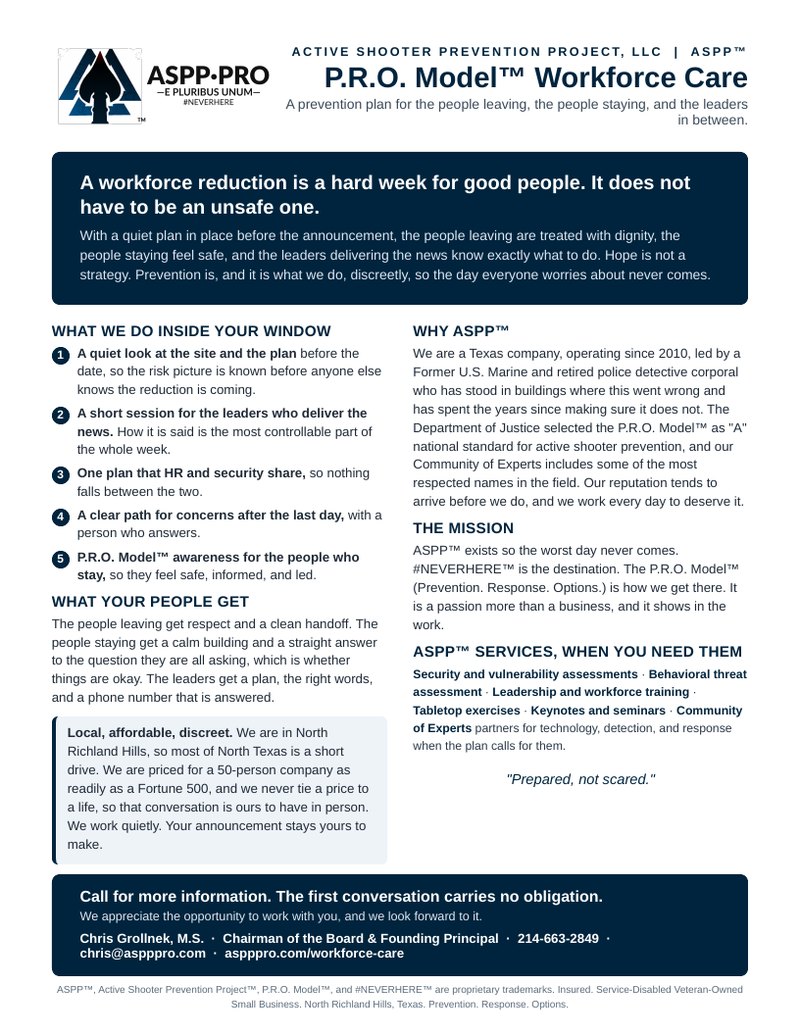
Download the one sheet, PDF, or call 214-663-2849.
Why we built this
We are not there to shut down jobs. We are also not against the technology reshaping your industry. Those are business decisions, and they belong to you. We are there so the people leaving are treated with dignity and the people staying feel safe. That may sound like the softer half of security. But it is the half the federal research keeps pointing at. The humanity piece is not adjacent to the prevention. In this pathway, it is the prevention.
This work is built on the P.R.O. Model™, “A” DOJ-selected national standard for active shooter prevention. It is in use at some installations and commands across the Department of Defense. Chris Grollnek created it. Former U.S. Marine and retired police detective corporal. The program scales from a 50-person company to an enterprise, because this level of care should never be a Fortune 500 luxury.
Read the one-sheet on workplace violence prevention during layoffs, or find it with our other materials on the Resources page.
The first conversation is free and carries no obligation. No pitch, no pressure. Start it here. #NEVERHERE™
Updated September 12, 2026. Written and reviewed by Chris Grollnek, Chairman of the Board & Founding Principal, Active Shooter Prevention Project, LLC (ASPP™). Former U.S. Marine and retired police detective corporal.