
Large venue active shooter prevention is not a doors-open problem. By the time the crowd arrives, the work that matters is already finished or already missed.
What large venue active shooter prevention actually involves
Venue walkthroughs. Access control review. Route and egress planning. Staff briefings for people who will never be described as security, because they are the ones standing closest to the public.
Most of it happens in empty buildings, months ahead, and none of it looks like security work from the outside.
Why a stadium is the hardest version of the problem
A stadium concentrates every variable at once. Tens of thousands of people, most of whom have never been in the building before. Hundreds of staff, many of them seasonal. Dozens of entry points. A schedule that cannot slip.
However, the underlying discipline does not change. Prevention is the study of what happens before an event, and a venue of that size simply raises the consequence of missing it.
Where the standard has been tested
We served as Active Shooter Prevention Coordinator for Super Bowl LVIII and Super Bowl LIX, and the same assessment work has been carried out across NBA and NHL venues.
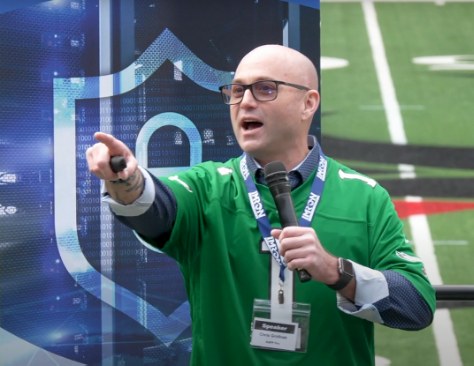
Chris Grollnek at SoFi Stadium, January 2025. Prevention work in large venues starts long before doors open.
Chris has written the first-person account of that work, from Las Vegas to New Orleans, in Play to Win: #NEVERHERE™.
Different sports, different buildings, and the same question every time. What does this venue know before anything happens, and who is expected to do something about it?
As a result, the findings travel. A gap identified in an arena in one city is usually present in the next one, because the buildings were designed against the same assumptions.
The same model, at scale
Large venue active shooter prevention runs on the same framework we take into a school district or a hospital. The P.R.O. Model™ is A national standard selected by the Department of Justice for 2022 to 2025, and again for 2026 to 2030.
Prevention. Response. Options. In that order.
Response capability at a major venue is genuinely excellent, because it has to be. That is exactly why prevention is where the remaining value sits. When the response side is already strong, the only ground left to gain is earlier.
What a smaller organization can take from this
Very few organizations run a stadium. Almost all of them run a building with doors, staff, visitors, and a schedule.
The methodology does not scale down by being watered down. It scales down by asking the same questions of a smaller room.
Destination #NEVERHERE™ is the goal. The P.R.O. Model™ is how we get there.
P.R.O. Model™ Workshops | Site Assessments | Request a consultation
A worked example of where a venue perimeter actually stops: the Beyond Wonderland Festival campground.
Share this article

Written by : Chris Grollnek
Active Shooter Expert Chris Grollnek (#activeshooterexpert) is a Former U.S. Marine and retired police detective corporal, the Chairman of the Board and Founding Principal of the Active Shooter Prevention Project (ASPP™), and the creator of the P.R.O. Model™, Prevention. Response. Options. Selected by the Department of Justice as "A" national standard for the Assistant United States Attorneys and across the department, and in use at some installations and commands across the Department of Defense. He is an international public speaker, trainer, educator, writer and director who has appeared in numerous documentaries, and he provides consulting to Fortune 500 companies and special events. Grollnek has testified about the terrorism and counterterrorism training needs of the United States before House Ways and Means, and in Senate testimony convened by Sen. Kay Bailey Hutchison in the Hart Senate Office Building in 2002. Ahead of that testimony, the Center for Strategic and International Studies (CSIS) in Washington, D.C. invited him to brief Ph.D. and senior executive staff of the U.S. Government on subterranean training, complex curriculum development and public lectures.
Latest articles
November 6, 2026
November 6, 2026
November 6, 2026