Good response training saves lives. It also starts too late to be the whole plan, and that gap is exactly where prevention lives.
Wondering where response training fits in a real prevention program? Talk with our team, and we’ll help you build the layers in the right order.
Here is something we say often, and mean every time: response training is good, and the people who teach it are on the same side we are. Run·Hide·Fight has given millions of people a simple plan they can remember under pressure. Multi-option programs have moved organizations past lockdown-only thinking. None of that is the problem. The problem is quieter, and it costs more than most leaders realize: somewhere along the way, response training became the entire plan and a response plan, by definition, begins after the worst has already started.
Give Response Training Its Due
Let’s be clear about what response training does well, because it does a lot. It replaces the freeze with a decision. It gives a teacher, a receptionist, or a shift worker three or four words they can act on when the thinking brain has gone quiet, and the body is running the show. It builds muscle memory that, on the worst day, buys seconds, and seconds save lives. We teach response, we respect the instructors who teach it, and we would never tell an organization to stop.
So this is not a case against response training. It is a case against asking response training to do a job it was never designed to do: prevent the event in the first place.
The Ceiling Every Response Model Shares
Every response approach, every single one, no matter the acronym shares one starting line: the moment the threat is already in motion. That is not a flaw in any particular program. It is simply what “response” means. The alert has sounded. The doors are moving. The clock has started. From that instant forward, even a flawless response is a race against time.
And here is the hard part for leaders to sit with: the most important decisions that determine how that day ends were already made or missed weeks and months before the alert. That is the ceiling. Response can do everything right and still only shape the last few minutes of a story that was largely written earlier.
The Math That Should Change the Plan
The numbers are not dramatic for drama’s sake; they are the reason we build the way we build. Law enforcement reaches the scene in an average of 12 to 15 minutes. The average active shooter incident lasts about 8 minutes, and many end in fewer than 4 minutes. Do that subtraction, and you see the problem no response plan can solve: help usually arrives after the event has already ended.
Now add the part almost everyone overlooks. In case after case, the warning signs were there. The FBI’s own research on pre-attack behaviors found that attackers typically display four to five observable warning signs in the weeks and months beforehand: changes in behavior, communicated intent, leakage, grievance, and a plan taking shape. The information existed. What broke down was not the presence of the signal. It was that no one was trained to see it, no one knew where to route it, and no team had the authority to act on it.
Hope is not a strategy, and response is not a plan; it’s the last layer of one.
The Missing Layer Has a Name: Prevention
If the decisive window opens before the alert, then the decisive work has to happen there too. That work is prevention, and it is not a slogan; it is a discipline with moving parts. It means teaching a community to recognize the pre-attack signals it will almost certainly see. It means a real behavioral threat assessment team with a clear process and the authority to intervene. It means an anonymous way to report a worry before it becomes a crisis, and an environment hardened at the seams that an attacker would actually exploit.
That is the layer we lead with, and we organize it under the P.R.O. Model™ Prevention. Response. Options. The order is deliberate. Prevention comes first because it is the only layer that can stop the clock before it ever starts. Response comes second because it still matters enormously when prevention needs help. Options come third because no plan survives contact with a real building, a real day, and real people unless it can flex.
Notice what that does to the conversation. Response training is no longer the whole answer being asked to carry weight it can’t hold. It becomes one strong layer inside a program that started working long before the worst moment, which is exactly where a good response program deserves to sit.
Response, Done Right, Still Matters
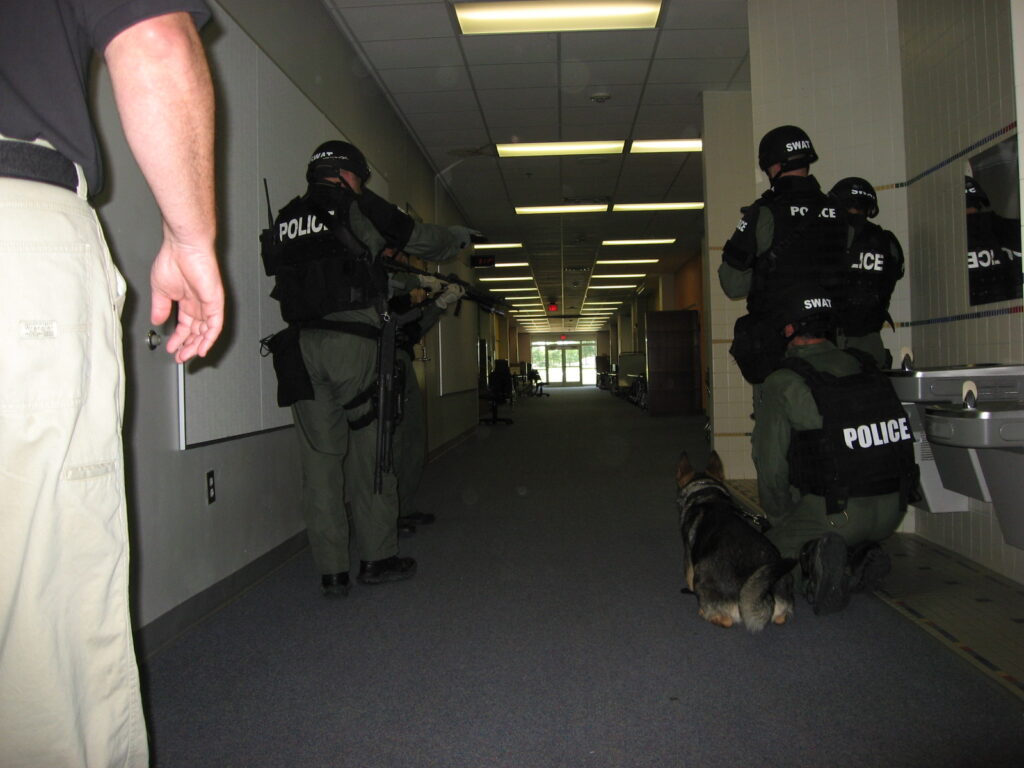
Response training like this matters in the moment; prevention is the layer that works long before the alert ever sounds.
Because we lead with prevention, people sometimes assume we treat response as an afterthought. The opposite is true. When prevention has narrowed the window, response finally has a fighting chance, and it needs to be simple enough to survive real stress. Our own response methodology is React, Escape, Survive: three words a person can remember when their nervous system has taken the wheel. React first and do something instead of freezing. Escape second and put distance and cover between yourself and the threat. Survive third with everything that keeps you alive until help arrives.
Three words, because three words are what people keep when everything else falls away. That is a response done right, not as the plan, but as the layer the plan can lean on.
Why This Standard, and Who Stands Behind It
We don’t ask anyone to take prevention-first on faith. The P.R.O. Model™ is an “A” National Standard for active shooter prevention, selected by the U.S. Department of Justice not once, but twice, across two administrations, for 2022–2025 and again for 2026–2030. Behind it stands a Community of Experts spanning detection, behavioral threat assessment, structural hardening, senior military and federal law-enforcement leadership, and emergency medicine, with hundreds of years of combined experience pointed at a single question: how do we stop the harm before it happens?
That is the standard we build to, and it is why we can say what we say without disrespecting the response community: keep your response training, and be proud of it. Then put the layer in front of it that changes the odds. Learn how the framework fits together on the P.R.O. Model™ page, or meet the expert behind the standard at chrisgrollnek.com.
Keep the response training. Add the layer that comes first.
Let’s build a program that works before the alert ever sounds. Contact our team. Prepared, not scared. We’re all on the road to Destination #NEVERHERE™.
Related reading
Share this article

Written by : Chris Grollnek
Active Shooter Expert Chris Grollnek (#activeshooterexpert) is a Former U.S. Marine and retired police detective corporal, the Chairman of the Board and Founding Principal of the Active Shooter Prevention Project (ASPP™), and the creator of the P.R.O. Model™, Prevention. Response. Options. Selected by the Department of Justice as "A" national standard for the Assistant United States Attorneys and across the department, and in use at some installations and commands across the Department of Defense. He is an international public speaker, trainer, educator, writer and director who has appeared in numerous documentaries, and he provides consulting to Fortune 500 companies and special events. Grollnek has testified about the terrorism and counterterrorism training needs of the United States before House Ways and Means, and in Senate testimony convened by Sen. Kay Bailey Hutchison in the Hart Senate Office Building in 2002. Ahead of that testimony, the Center for Strategic and International Studies (CSIS) in Washington, D.C. invited him to brief Ph.D. and senior executive staff of the U.S. Government on subterranean training, complex curriculum development and public lectures.
Latest articles
November 6, 2026
November 6, 2026
November 6, 2026