
Digital Twins for Prevention
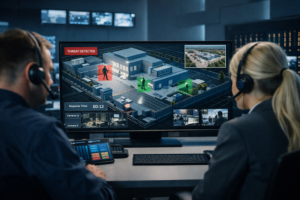
An illustrative example of how digital twins support prevention-first planning, training, and informed decision-making in public safety environments.The next phase of safety is not reactive. It is predictive, informed, and designed to help people make better decisions before risk becomes harm.
Digital twins are dynamic, data-driven representations of real-world environments. When used responsibly, they help organizations understand space, movement, systems, and risk in ways that were not previously possible.
This is not about technology for technology’s sake. It is about giving people time, clarity, and options, the foundations of effective prevention.
Why Digital Twins Matter Now
Across public safety, defense, education, healthcare, and critical infrastructure, leaders are managing increasingly complex environments. Facilities are larger, systems are more interconnected, and all-hazards risks are harder to anticipate in isolation.
Digital twins help organizations:
- Visualize environments before a crisis occurs
- Test scenarios without disrupting operations
- Identify vulnerabilities and inefficiencies early
- Improve coordination between people, process, and technology
- Train decision-makers using realistic, data-informed context
Most importantly, digital twins support prevention-first thinking, helping organizations act earlier, not just faster.
Prevention Is a Data Problem Before It Is a Response Problem
Historically, safety planning has focused on what happens during an incident. Digital twins shift that focus upstream.
By integrating spatial data, access points, sensor inputs, and operational workflows, digital twins help organizations understand how risk accumulates over time. This enables earlier intervention through design changes, policy adjustments, training, and responsible technology integration before a situation escalates.
This approach aligns directly with the P.R.O. Model™ (Prevention. Response. Options.), where prevention is a measurable, repeatable discipline.
Leadership in Digital Twin-Enabled Prevention
Chris Grollnek is known for advancing prevention strategies grounded in facts, data, and real-world experience rather than emotional reaction. That same philosophy drives how digital twins can support active shooter prevention and broader all-hazards planning.
Through the Active Shooter Prevention Project™ (ASPP™), digital twins are not treated as a standalone solution, but as an enabling layer that supports better training, clearer communication, and more informed decision-making.
In active shooter prevention specifically, digital twins help organizations:
- Understand how people move through real spaces
- Identify sightlines, bottlenecks, and operational challenges
- Coordinate technology such as cameras, detection systems, and access control
- Train leaders and teams without fear-based simulations
This is how technology serves people, not the other way around.
Training for the Environments People Actually Work In
One of the most practical benefits of digital twins is their role in training and education.
Traditional training often relies on generic floor plans or abstract scenarios. Digital twins allow training to occur in the actual environments people occupy every day, improving relevance and retention.
Within ASPP programs, this supports:
- Prevention-first seminars for leadership teams
- Scenario-based tabletop exercises grounded in real layouts
- Non-fear-based soft walk-throughs using digital representations
- Cross-functional coordination between security, operations, and leadership
Training becomes less about adrenaline and more about judgment, awareness, and shared responsibility.
The Next Phase of Solutions Applied Today
Digital twins are not a future concept. They are being applied today to improve safety planning and risk reduction across government, defense, and the private sector.
When combined with the P.R.O. Model™, digital twins help organizations move beyond fragmented tools toward integrated prevention systems that are ethical, scalable, and grounded in reality.
This is not about predicting every outcome. It is about reducing uncertainty, improving preparedness, and protecting people with intention rather than fear.
Preparing People for Technology-Enabled Prevention
The question leaders are asking is no longer if technology will shape prevention, but whether their people are prepared to use it wisely.
Are your teams trained to understand the environments they operate in? Do your leaders have the tools to make informed decisions before risk escalates?
If you are ready to learn more, consider participating in a seminar or training program designed to help your most valuable asset, your people, work effectively with technology.
That is how organizations move, deliberately and responsibly, toward Destination #NEVERHERE™.
Learn more at aspppro.com
Digital Twins for Prevention
Chris Grollnek’s prevention-first work emphasizes the same evidence-based principles found across federal guidance: early identification, informed intervention, and systems designed to reduce risk before escalation.
Share this article

Written by : Chris Grollnek
Active Shooter Expert Chris Grollnek (#activeshooterexpert) is a highly sought-after international public speaker, trainer, educator, writer, and director and has appeared in numerous documentaries. Active Shooter Expert Chris Grollnek also provides specialized consulting services to Fortune 500 companies and special events. Grollnek has testified about the Terrorism and Counterterrorism training needs of the United States and beyond before the U.S. Senate Ways and Means subcommittees in the Hart Senate office building in 2002. Leading up to his testimony before the U.S. Senate, Chris Grollnek was invited by the Center for Strategic and International Studies (CSIS) in Washington D.C. to provide insight to Ph.D. and Senior Executives Staff of the U.S. Government on subterranean training, complex curriculum development, and public lectures.
Latest articles

June 5, 2026
June 5, 2026
June 5, 2026
