
Article Written by Tod Langley
Most national averages indicate the annual employee turnover rate is 18%.
Leaders are constantly concerned about the minimum amount of training required for safety and security, compared to what is actually needed to ensure a high degree of preparedness, especially for something like an emergency. When an incident overwhelms the capabilities of the organization, there is a crisis. A crisis leads to higher loss of life, significant disruption in operations, loss of revenue, increased employee concerns, legal fees, loss of reputation, and a longer road to recovery.
Studies cite the need to revisit protocols, policies, and best practices over 4 times in 3 months to ensure higher knowledge retention. Crisis Response Leadership Training (CRLT) takes that as an indicator that recurring training combined with increased complexity of training is important to information recall, particularly for stressful situations. This is not a new theory and is reinforced through the Federal Emergency Management Agency’s (FEMA) National Incident Management System (NIMS) in the Crawl-Walk-Run and Increased Complexity of Training guidelines.
But what does that mean to an executive leader?
A good example is to think of how many times training must occur at the individual employee level on an annual basis to achieve quarterly training objectives. For a company with 1,000 employees this means training 4,000 total individuals (based on quarterly training objectives). Add in the complexity of an 18% turnover rate, which can also be used to assume that a vast majority of the company structure will be completely different in 5 years, and you can see that traditional approaches to training will be significantly challenged in creating preparedness for the organization.
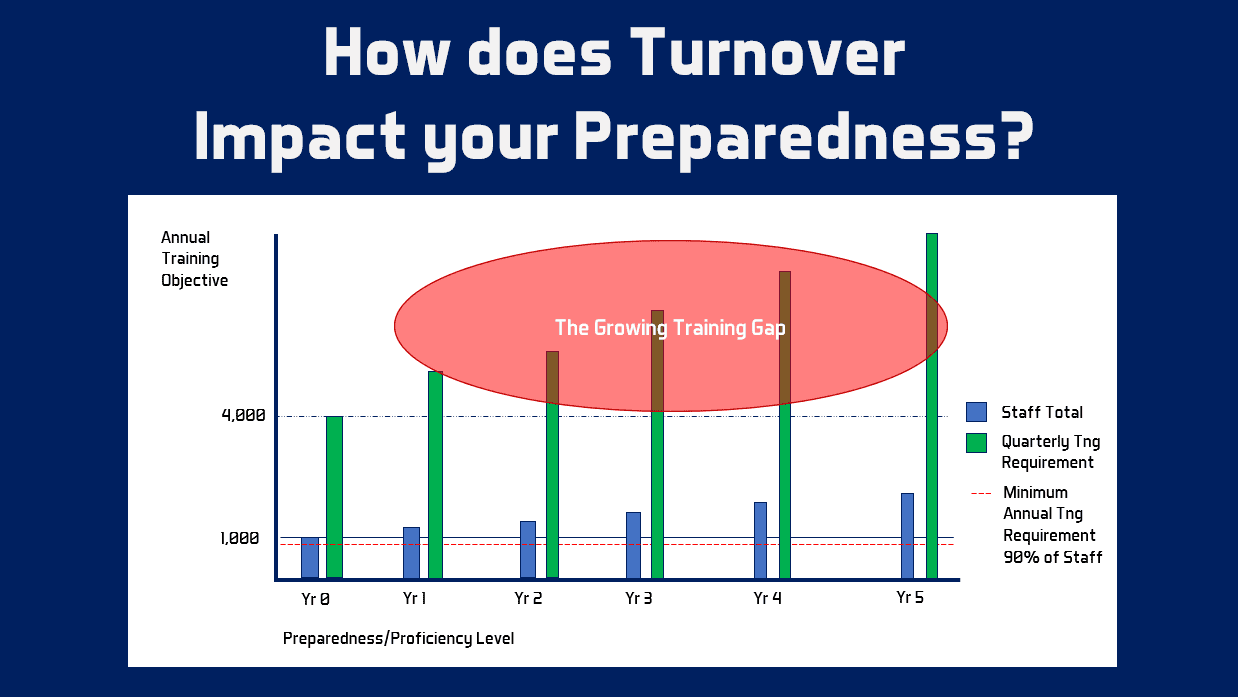
What percentage of the total organization can you train per year? What is your level of preparedness based on those training opportunities? Will they be justifiable and defendable if a worst-case scenario does occur within your organization? There is growing public and government sentiment to increase an organization’s responsibility to provide a safe and secure workplace. There is an equally growing call for accountability of first responder leaders to ensure they are prepared for Incident and Unified Command operations.
Establishing and enforcing a standard are in stark contrast to the realities of actually training and preparing an organization. We do not mean to dismiss the training challenges we face as a society.
As an example, a nationally recognized institution responsible for providing active shooter response training claims to have trained over 300,000 first responders since 2002. There are over 4.5 million first responders within the U.S. The throughput of trained personnel per year, according to these statistics, is close to 14,500…or a staggeringly low .3% of the total first responder community. If the national average holds true for first responders, as it does in the other U.S.-based industries, then there is a significant and increasing deficit between the need for training, preparedness, and what can actually be accomplished through traditional (even well financed), institutional training programs. A counter-argument to this assessment is that these programs are intended to establish a “baseline” of knowledge and standards that trained personnel take back to their organizations and share with their peers. There is goodness in this approach. However, consider the issue of turnover compared to the “trickle down” effect; the reduced amount of time that a trained individual focuses on the subject, combined with extended breaks between remedial training, lack of practical application, and turnover rates all indicate that a “watered-down” version of what was originally taught is having a reduced preparedness impact within the organization. If this example holds true for one of our finest institutions, what does it mean for the rest of us that are concerned about public safety and security?
Frequency of recurring training and the challenging, structured nature of the learning objectives are key to developing higher knowledge retention (recall) rates. Modern learning methods may refer to the Visual Learning Method or the Complex Adaptive Methodology. Both approaches may be vital to changing the training and preparedness paradigm.
What, then, can be done to supplement or enhance current training methods to reinforce training objectives and increase preparedness?
Simulation technology, particularly using gamification, is a solution that is there for you! A software simulation oriented on safety and security polices and best practices, specific to your organization, can have numerous advantages.
The benefits of incorporating simulations into your training include:
Professional Development
- Reinforce Training Objectives
- Enhance and Reinforce Existing Training Programs
- Increase Repetition with Minimal Logistics and Planning Requirements
- Increase the Scope and Scale of Training Scenarios
- Increase the Size of your Training Audience at Reduced Costs
- Track Training Compliance and Knowledge Retention
- Increase the Efficiency and Preparedness of your Organization
- Immersive Training in a Controlled, Risk-free Environment
- Increased Engagement and Knowledge Retention while Decreasing Down Time
- Allows for Repetitive Practice of specific Scenarios to Retain Information
- Enforce Decision-making Skills in High Pressure Scenarios
- Simulation Technology provides Real-time Feedback, allowing for Immediate Correction of Mistakes
- Cost-effective- Full scale Training without the Cost, Time, and added Risks of “Live Events”

Crisis Response Leader Training (CRLT), Inc. is a software simulation company that provides a tabletop-style solution to help leaders develop critical decision-making skills. CRLT integrates Learning Management Systems directly within 3D scenarios and environments to support training and preparedness. CRLT provides unlimited, recurring training for an organization anywhere across the globe via cloud-based services, along with significant data analytics to support tracking compliance. These features make them a unique service designed specifically to address the current training and preparedness paradigm. CRLT’s The Incident simulation is engaging and challenging for individual employees up to executive-level leaders, as well as, the first responder community. Their system is highly customizable and tailorable to your needs.
CRLT is a member of the Active Shooter Prevention Project. Together, #NEVERHERE becomes the rallying call for innovative change that helps us increase preparedness and save innocent lives.
Share this article

Written by : Tod Langley
Latest articles

May 16, 2026

May 16, 2026
May 16, 2026
