
I realize that everyone’s path is different. But I wanted to share a bit of my personal journey towards preparedness, how it led to my life’s professions and inspired me to be ‘the preparedness guy.’
I was born in 1966. Now, that may leave me out of touch with some of you who were born in a year beginning with a 2, but hear me out.
As I approached the 5th grade, I was focused on becoming a Boy Scout. When I turned 10, I attended the very next meeting of Boy Scout Troop 44, in Poland, Ohio. The Scoutmaster was Ray Slaven.
Interestingly enough, I was never a Cub Scout and had no interest in Cub Scouts but was driven towards the Boy Scouts. I can’t remember how many books about Scouting I read before joining Troop 44.
Interestingly enough, I was never a Cub Scout and had no interest in Cub Scouts but was driven towards the Boy Scouts. I can’t remember how many books about Scouting I read before joining Troop 44.
In hindsight, I have to say that as a teenager, Boy Scouts is what I DID. I was academically oriented at school, and always interested in science. My enthusiasm was with the Boy Scouts, however.
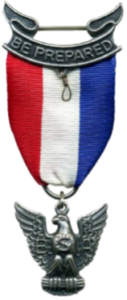
I embraced Scouts. I earned my Eagle Scout rank just before I turned 14. After that, I earned all of my Eagle Palms, which are for merit badges earned beyond those required for Eagle. In total, I earned 37 merit badges. Certainly, others have earned many more than I did. I progressed from Patrol Leader, eventually becoming the troop’s Senior Patrol Leader. I went to Boy Scout Camp every summer. I visited one National Jamboree and attended another National Jamboree as the Quartermaster.
Growing up in Ohio, I had my first alpine experience at Philmont Scout Ranch in Cimarron, NM – climbing 12,441-foot-tall Mount Baldy at age 16. I was a member of the Order of the Arrow and eventually became Vigil Honor member of the Order of the Arrow in Nea-to-ka Lodge 396. I became a law enforcement explorer and served as the postpresident.
I say all this not to tout my accomplishments, but to relay a sense of just how much I was focused on preparedness. It has become an integral part of my adult personality and my adult professions.
As a 14-year-old Boy Scout I found myself Interested in wilderness survival, first aid and emergency preparedness. I recall participating in a training exercise with the local Volunteer Fire Department. Together with the Police Department, they brought in a couple of old wrecked cars. We had moulage kits provided by the American Red Cross, and accident victim roleplayers. We as a troop worked through how we could safely react and assist in a traffic accident.
I have recently been working on a mentoring project with some fifth graders, which caused me to reflect a little bit about that time in my own life.
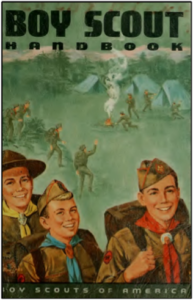
So, back to the books I read before becoming a Boy Scout. One of those books, of course, was the Boy Scout Handbook. This particular one was the 1967 Official Boy Scout Handbook. I probably read it 500 times.
Now, more than 50 years later, I want to share some of this handbook with you. Specifically, a few sentences related to preparedness, emergencies, bravery, and mindset.
I will let you make your own assessments of how pertinent these statements might be today. I would also like to point out that this information was designed for 10- and 11-year-olds.
Preparedness
Now, of course, the Boy Scout motto is Be Prepared. The handbook states that this means that you are always in a state of readiness in mind and body to do your duty and to face danger if necessary to help others.
There is an example in the handbook of a school bus accident where the driver was seriously hurt, but a young Scout was able to take command of the situation. When asked about it afterwards, the boy said “Well, the first time I traveled on that bus, I asked myself, what will I do if we ever have an accident?” He thought out in advance what might have to be done in case of an accident. He acted, because he was confident in his ability to help, and he knew what he needed to do.
Emergencies
The handbook says that by learning in advance exactly what to do, you’ll be ready to help the moment an emergency strikes. Further, the confidence you show because you know what to do, the common sense you display in doing things, and your calmness all positively contribute to the outcome.
There is also a discussion of what the handbook calls “hurry cases”. There are cases where someone’s life is at stake, and a Scout is expected to move with utmost speed. The quote from the handbook is this:
“JUMP TO THE JOB – A second saved may mean a life saved.”
What are those three hurry cases? Here’s the exact language from the handbook:
1. Blood is spurting or gushing from a wound. It must be stopped immediately.
2. Breathing has ceased. It must be started again by artificial respiration.
3. Poison has been swallowed. It must be made harmless.
Bravery
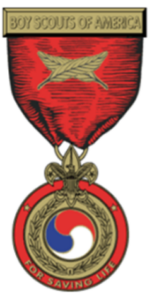
Bravery is one of the 12 points of the Scout Law. “A scout is Brave”. As described in the handbook, the highest award a Scout can receive is the Honor Medal for Lifesaving.
This award is not earned just by just rescuing someone. It is given only if the deed required real heroism and was done at the risk of the Scout’s own life. The handbook goes on to make this statement:
Those boys had a glorious opportunity to prove their bravery and were prepared to act.
Your opportunity may come. Will you be ready for it?
 If it had to come down to one single facet of what the Boy Scouts provided to me personally, it was this. It became my guiding principle. It is rooted in the heart of my personality to this day. Will I be ready to act when my opportunity to save another comes? It is also not insignificant that this is termed an ‘opportunity.’
I have indeed had moments in my life since when I have had just that opportunity. I was ready and prepared to act. Thankfully, there were not many of those moments, but each one was a very poignant moment in my life. The job is not done – there will be more opportunities.
We should all strive to answer that same question: Are we ready and prepared to act when my opportunity to save another comes?
Mindset
Of course, in 1967, the term ‘mindset’ was not used in common conversation. But the statements in the handbook related to this are rather described as being about ‘thinking’.
“In today’s world (1967!), the most important thing you can learn to do is to think. The ability to think – and especially to think fast – usually goes with a mind that is alert and interested and always inquiring. Thinking fast and in an emergency also depends on the habit of figuring out things in advance. You do it because you’ve thought out in advance what you would have to do if just such an accident should happen.”
So, today, what are our key points, in talking about active assailant awareness?
We talk about:
• Situational Awareness.
• Mindset.
• Having a Plan in Advance.
Certainly, today’s world is substantially different than that of 1967, but I think we can all learn from the Boy Scout Handbook of 1967:
• Do you know how to handle the three ‘hurry cases’?
• Do you know what to do in case of an accident or other emergency?
• Do you consider yourself to be in a state of readiness in mind and body? Are you prepared to help in an emergency?
• Have you thought about what you would do in advance if such an accident or emergency should happen?
• Your opportunity may come. Will you be ready for it?
I encourage every one of you reading this to consider the answers to these questions for yourself. If you happen to be the parent of a 10-year-old (or older) child, you should consider how they might answer these questions for themselves. Maybe it’s time to do some more learning together and be better prepared when the opportunity presents itself.
Be safe, be ready, and have a plan!
Updated for 2024 from ‘The 1967 Boy Scout Handbook: Reflections from 2023’, originally published at https://trainbeready.com/f/the-1967-boy-scout-handbook-reflections-from-2023
Share this article
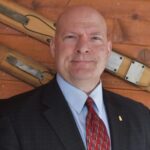
Written by : Glenn G Norling
Latest articles
May 16, 2026

May 16, 2026
May 16, 2026
